
Tel: 020 7620 1818 email: cookandbutler@btconnect.com
Farringdon Ward Club
Annual Civic Lunch
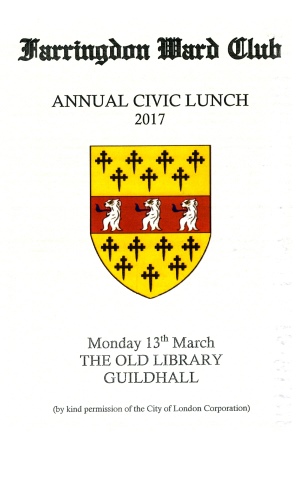
March 2017, The Old Library, Guildhall, City of London

Annual Civic Lunch
March 2017, The Old Library, Guildhall, City of London
Annual Civic Lunch
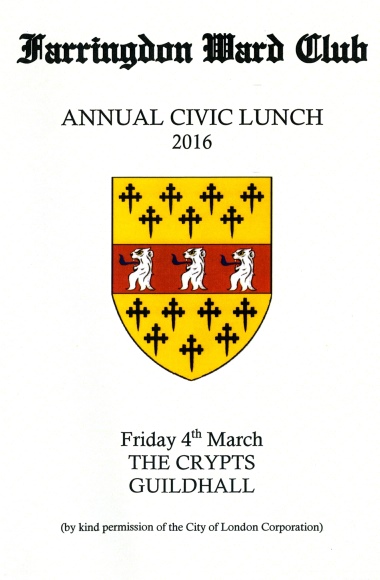
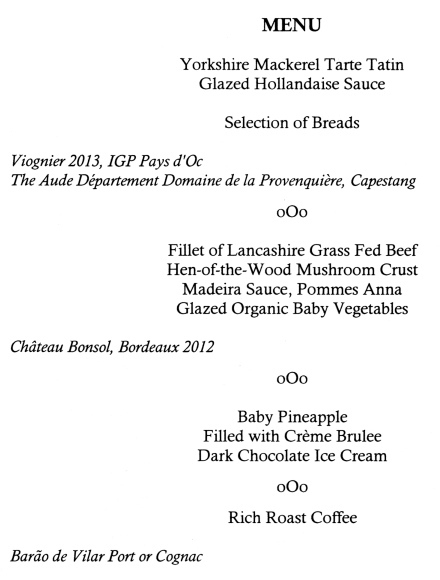
March 2016, The Crypts, Guildhall, City of London
Annual Civic Lunch
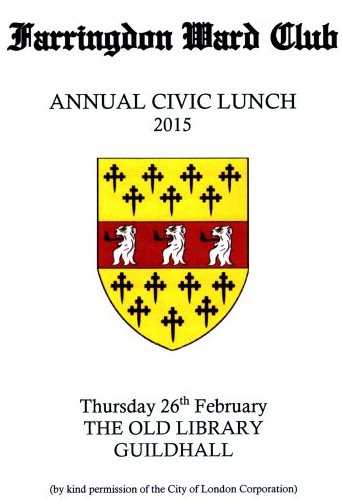
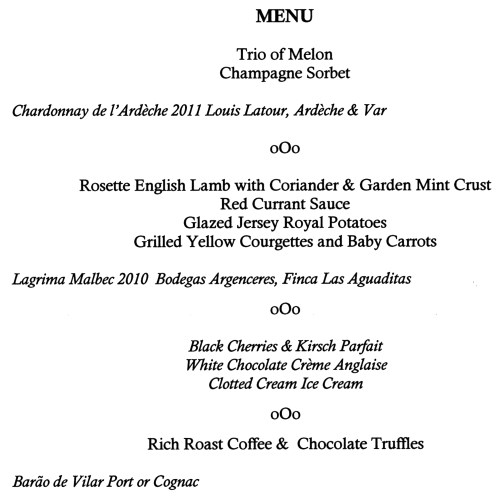
February 2015, The Old Library, Guildhall, City of London
Annual Civic Lunch
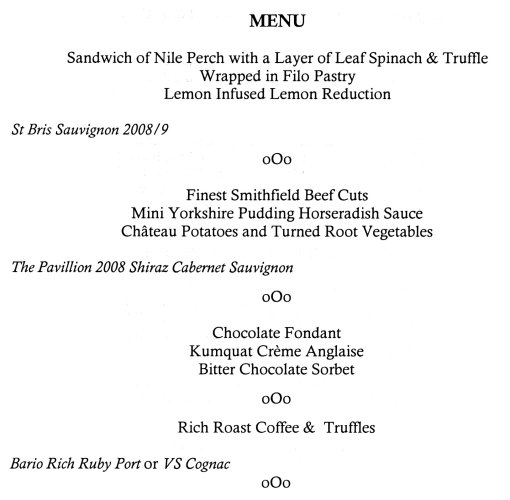
April 2011, The Crypts, Guildhall, City of London
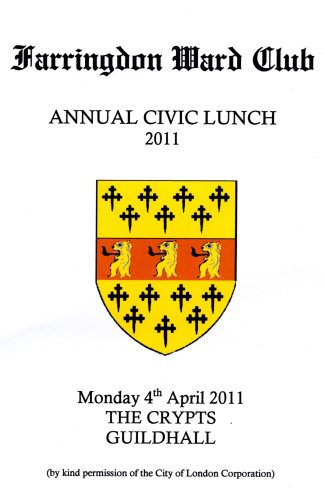
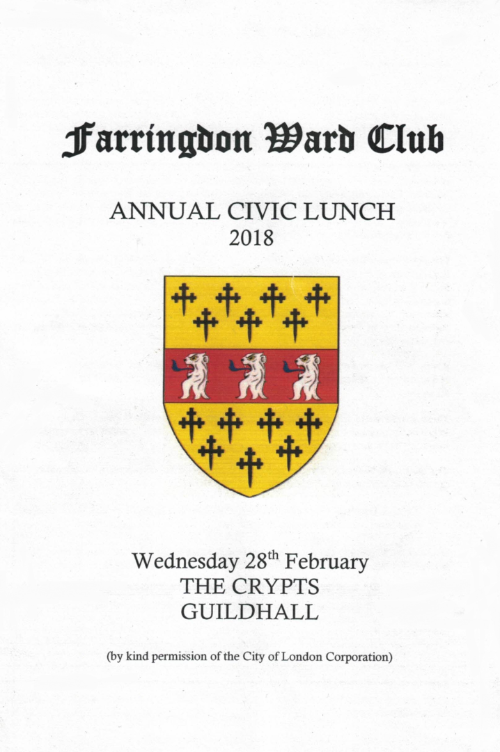
THE NAME AND ARMS OF FARRINGDON
A Past President, and former Garter King of Arms, the late Sir A Cohn Cole KCB KCVO TD CC, wrote:
The Club has for a long time displayed the Arms of
Nicholas Faryngton, Mayor of London in the years 1308, 1313, 1320 and 1323.
He was a goldsmith, and in one record at the College of Arms, he is
described as a knight but does not style himself as such in his Will of
1334.
Some fifty years earlier, one William Farrindon had been, in 1281, “Shreife”
of the City of London, and to him were attributed Arms similar to those
borne later by the Mayor Nicholas Faryngton, who was William’s son-in-law.
William Farrindon’s origins are traceable perhaps to Farringdon, a place
name in Devon, which occurs also as “Ferentone”, Ferhendone” and “Ferndon”.
As “Ferhendone”, meaning “Fern clad down”, it occurs in Domesday Book.
The above mentioned William Farrindon, or William de Farindon, made his Will
in 1292-4, leaving his tenements in the City of London to his son-in-law
Nicholas (son of Ralph le Fevre) who thereupon it may be presumed took his
father-in-law’s name and became Nicholas Farrindon, making his own Will in
1334 as “Nicholas de Farndon, Alderman” by which Will he gave and devised
“Le Aldermanrie” of Farndon, ie the Aldermanship of Faringdon of which he
was seised as of his own property, to John de Pulteneye, Mayor in 1330 and
1331.
It was William de Farringdon, Nicholas’ father-in-law, who gave his name to
the Ward of Faringdon or “Farndone” which previously had been called the
Ward of Ludgate and Newgate.
These variations of the name in City of London records make it highly likely
that the Ward of Farringdon carries a name deriving from Devon, which name
was there subject to similar variations from time to time.
The Arms of Nicholas Farringdon (as the name came to be) may be blazoned (ie
described in the language of heraldry) as follows:
“Or on a fesse gules between fourteen cross crosslets fitchy sable three
lions heads erased Argent”
In everyday language, the Arms can be described as “gold on a horizontal
band of red between fourteen black crosses crosslet each pointed at its foot
three lions’ heads torn off at the neck each of silver”.
Crosses appear frequently in heraldry and take many forms, generally being
meant as christian symbols, and lions and lions’ heads are also popular
devices, sometimes being intended to allude to the Lions “passant gardant”
in the Arms of England. Whether the lions’ heads of Farringdon have this
significance is a question. However, in these Arms, which are older than
those of the City of London (the Cross and Sword of the City Arms dating
from 1381) it is just possible that the leopard’s head (or lion’s head
full-faced) used from at least 1300 by the goldsmiths of London as a
hall-mark on articles of gold and silver, inspired the choice of lions’
heads in the Arms of so prominent a goldsmith as Nicholas Farringdon.