
Tel: 020 7620 1818 email: cookandbutler@btconnect.com
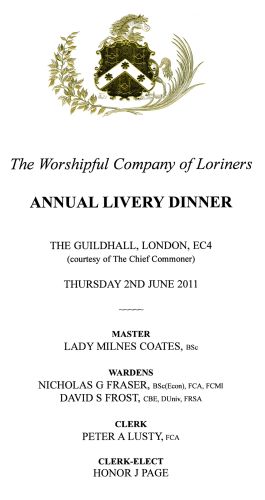
The Worshipful Company of Loriners
www.loriner.co.uk
Annual
Livery Dinner
June 2011, Guildall, City of London

THE FIRST 750 YEARS
The Loriner makes and sells bits, bridles, spurs, stirrups, saddle trees and
the minor metal items of a horse’s harness.
The Company’s first Ordinances were granted in 1261, earlier than those of
any other craft (except the Cappers, who were later absorbed by the
Haberdashers). In 1393 new Ordinances were made, and again in 1489, 1714 and
1 741, the last being those by which the Company is governed to this day.
The first surviving reference to Loriners’ Hall is found in Pepys’ diary of
1668. The Hall stood on the corner of Aldermanbury Postern and London Wall,
facing Basinghall Street, and was leased from the Corporation. The Company
relinquished the lease in 1759.
By a Royal Charter of 1711, in the reign of Queen Anne, the Company achieved
incorporation in the style of “The Master, Wardens, Assistants and
Commonalty of Loriners, London”.
By the end of the nineteenth century the Company had almost no role in
relation to its craft. However, it did have the reputation of being very
attractive in its social aspects, as well as of being a great force in the
public life of the City. Since 1848 there have been thirty-seven Loriner
Lord Mayors and at least sixty-six Loriner Sheriffs.
In 1932 the Court of Aldermen fixed the number of liverymen permitted to the
Company at 500, the number today fluctuating around 450. Since 1989 ladies
have been admitted to the livery. The first two ladies elected through the
Livery were installed as Master in 2010 and 2011.
Today the Company supports courses in lorinery at Capel Manor College, has
published a leaflet on bits and bitting, funded veterinary research at
Cambridge University and promoted British Standards for saddle trees. It
supports organisations including the Riding for the Disabled Association,
the Pony Club and the Ebony Horse Club as well as Service equestrian events.
It has strong relationships with the King’s Troop, Royal Horse Artillery,
the Household Cavalry Mounted Regiment, the Naval Riding Centre and 216
(Blues and Royals) Army Cadet Force Detachment.
A set of stirrups for the State Coach’s postilion riders was presented to
Her Majesty Queen Elizabeth II during the Golden Jubilee Year of 2002.
The Company has made many distinguished horsemen and horsewomen Honorary
Freemen or Honorary Liverymen — the most notable example being HRH The
Princess Royal, Master in 1992.