
Tel: 020 7620 1818 email: cookandbutler@btconnect.com
The Worshipful Company of Wheelwrights
www.wheelwrights.org
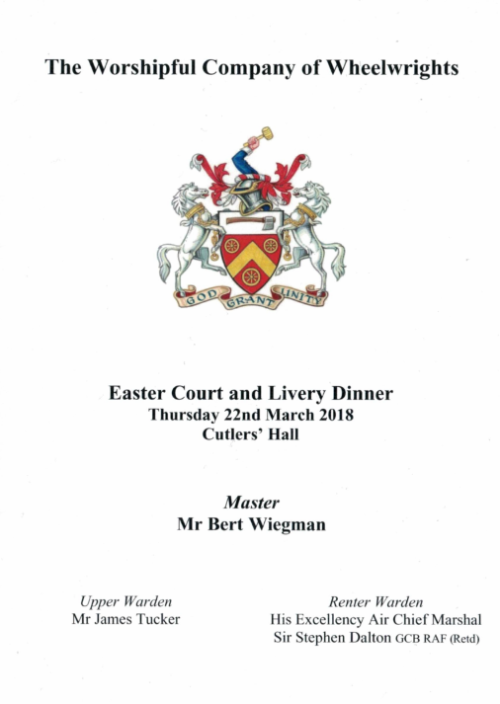
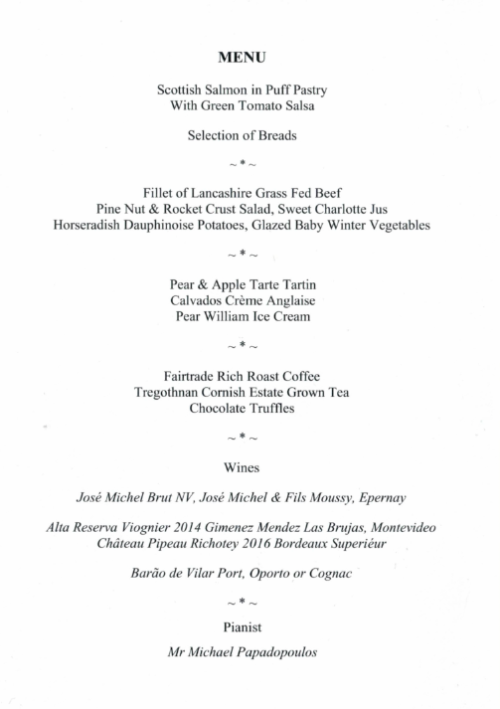
Easter Court & Livery Dinner
March 2018, Cutlers' Hall, London

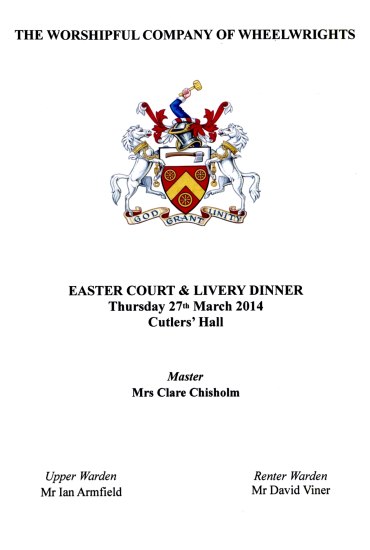
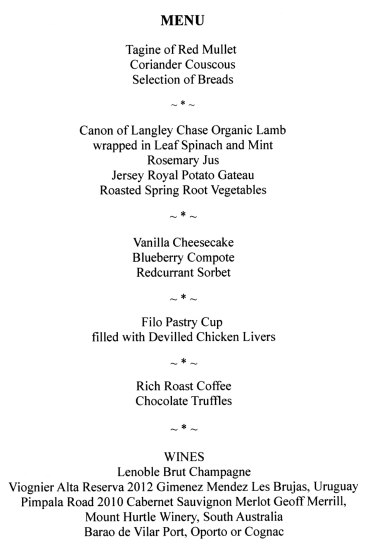
Easter Court & Livery Dinner
March 2014, Cutlers' Hall, London
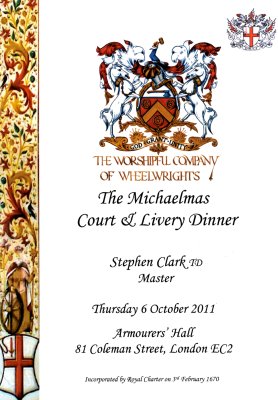
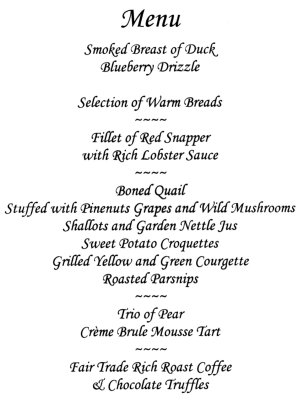
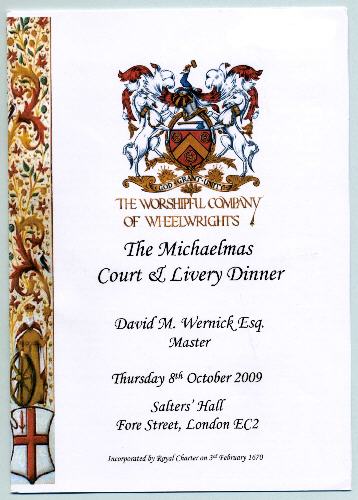
Michaelmas Court & Livery
Dinner
October 2011, Armourers' Hall, London
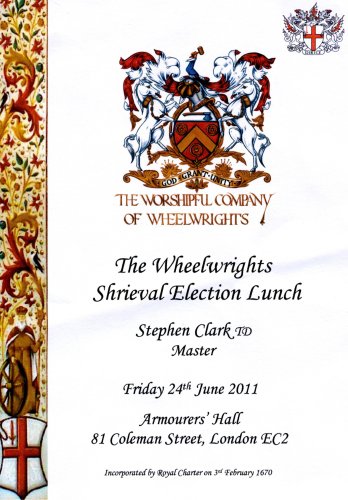
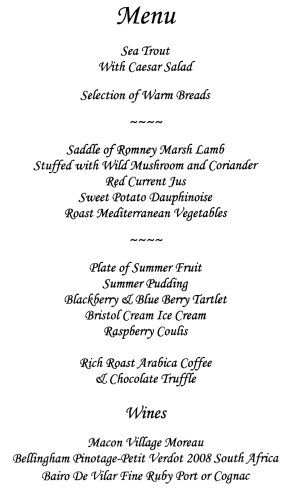
Shrieval Election Lunch
June 2011, Armourers' Hall, London
Michaelmas
Court and Livery
Dinner
October 2009, Salters' Hall, London
The Worshipful Company of Wheelwrights
Whilst the wheelwrights craft has been practised for more
than 4000 years, it was only in 1630 that the Wheelwrights of London, having
become sufficiently wealthy to pay the costs and legal fees involved in
incorporation, formed a committee to approach the City authorities. Later
that year the leading wheelwrights and coachmakers came together and
petitioned for incorporation as a single company.
In the next thirty years or so the City was preoccupied with other matters
including the Civil War, the Commonwealth under Oliver Cromwell, the Dutch
War, the great Plague and the Fire of London.
The wheelwrights, independently of the coachmakers made a separate petition
for incorporation and on 3rd February 1670, Charles II granted the
wheelwrights a Charter. The Worshipful Company of Wheelwrights became, in
order of precedence, the sixty-eighth Lively Company of the City of London.
Considerable changes took place in the last quarter of the 18th Century. On
the one hand the Company flourished growing in both numbers and social
status. The Company applied for and obtained a grant of Livery in 1763 and
in 1793 it achieved the distinction of providing its first Lord Mayor of
London - Sir Robert Peckham.
On the other hand by 1801 it was discovered that there was not one
practising craftsman amongst the Company’s membership. There is little
doubt that this came about as a result of the greatly increased worldwide
trade that was passing through the City. This in turn led to high rents and
wages so that even those men who had started life as craftsmen were probably
finding more lucrative employment for themselves or more profitable use for
their premises. In short, the craft had left the City and moved to the
surrounding countryside.
In November 1817 twenty-seven new Liverymen were admitted to the Company,
amongst them were four drapers, four brokers, two grocers, two ship owners,
two pawnbrokers and one fishmonger, there were no wheelwrights. In 1872
after an interval of nearly a century the Company again turned its attention
to its responsibilities to the craft and in 1882 became a founding member of
the City & Guilds of London Institute. In 1892 the Court appointed a
Technical Education Committee which, in conjunction with the Carpenters
Company, established a class for Wheelwrights at the Carpenters Training
School in great Titchfield Street. Whilst suffering from declining numbers
these classes continued until the outbreak of the Second World War. The
Company continues to support the craft.
Furthermore, there are now three working wheelwrights who are liverymen and
four who are yeomen of the Company. The Wheelwrights Company maintains a
close connection with the City of London and one of its principal roles is
to support the Mayoralty and Corporation. The Company is especially proud
of the fact that seven of its members have, over the years, served as
Sheriff and Lord of London. They are Sir Robert Peckham in 1793, Sir George
Bridges in 1819, Sir William Dunn in 1915, Lord Ebbisham of Cobham in 1926,
Sir Murray Fox in 1974, Sir Anthony Jolliffe in 1982, and Alderman Sir David
Rowe-Ham in1987. In addition Michael N. Hinton, Clerk to the Company from
1965 to 1972 was Alderman Sheriff in 1977/78, and Kenneth Ballard and John
Taylor served as Sheriff in 1978/79 and 990/91. Past Master Richard Sermon
MBE was installed as Sheriff on 28 September 2010 to serve throughout
2010/11.