
Tel: 020 7620 1818 email: cookandbutler@btconnect.com Company Number 05143672
The City of London Finest Luncheons
The River Thames Luncheon Club
May 2026

The River Thames Luncheon Club Friday 8th May 2026
Luncheon Menu |
The River Thames Luncheon Club Bookings |
Wines |
|
Garden Pea & Mint Leaf Soup
|
Book this Georgian Hall The Luncheon Club is an opportunity to promote the fabulous hospitality and historic setting of the Watermen's Hall. We would be delighted to hear from any of your friends or associated organizations for Meeting Luncheon Dinner Please email cookandbutler@btconnect.com to make event reservation or enquires &&& The River Thames Luncheon Club Bookings 2026 Dates – All Fully Booked 2027 Dates – We will open the booking Diary for 2027 In September 2026. As a priority client you will have September to consider your dates before we allow other bookings to be made from October |
Barão de Vilar White Port &&& Sauvignon Blanc 2024 IGP Pays d'Oc Domaine Bergon Vias Languedoc &&& Bonfaro Tinto The Beautiful Lighthouse DFJ Vinhos IGP Lisboa &&& Les Remparts de Bastor-Lamontagne, 2022 Sauternes &&& Barão de Vilar Port |
On this Day
did Germany sign Instrument of Surrender a legal
document effecting
the unconditional
surrender of
the remaining German armed
forces to
the Allies, ending
World War II in Europe.
It was signed at 22:43 CET on
8 May 1945
and took effect at 23:01 CET on the same day. But the day
before, Germany had signed another surrender document with the
Allies in Reims in
France 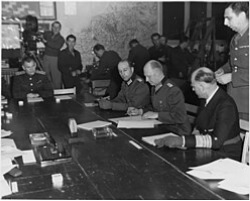
General Alfred Jodl signing the capitulation papers of unconditional surrender in Reims, France. Text of the preliminary instrument of surrender UNDERTAKING GIVEN BY CERTAIN GERMAN EMISSARIES TO THE ALLIED HIGH COMMANDS It is agreed by the German emissaries undersigned that the following German officers will arrive at a place and time designated by the Supreme Commander, Allied Expeditionary Force, and the Soviet High Command prepared, with plenary powers, to execute a formal ratification on behalf of the German High Command of this act of Unconditional Surrender of the German armed forces. Chief of the High Command; Commander-in-Chief of the Army; Commander-in- Chief of the Navy; Commander-in-Chief of the Air Forces. SIGNED JODL Representing the German High Command. DATED 0241 7 May 1945 Rheims, France. The signing was not recognized by the Soviet Union, which demanded among other things that the act of surrender should take place at the seat of government of Nazi Germany from where German aggression had been initiated. Therefore, another document needed to be signed. In addition, immediately after signing the first document, the German forces were ordered to cease fire in the west and continue fighting in the east |
Germany under the Flensburg Government led by the
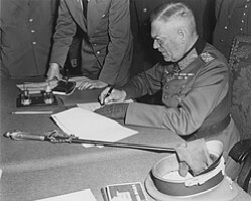
head of state, Grand-Admiral Karl Dönitz, also accepted the Allied suggestion to sign a new document. The document was signed at the seat of the Soviet Military Administration the Soviet headquarters in Berlin-Karlshorst, now the German-Russian Museum. by representatives from the German Oberkommando der Wehrmacht the Allied Expeditionary Force represented by the British, and the Supreme High Command of the Soviet Red Army, with further French and American representatives signing as witnesses. This time, Field- Marshal Wilhelm Keitel was the highest ranking representative of Germany at the signing ceremony.
Nazi Germany. As one result of the German downfall, the Allies had de facto occupied Germany since the German defeat – which was later confirmed via the Berlin Declaration by the four countries of Allies as the common representative of new Germany (France, USSR, UK and the US), on 5 June 1945. There were three versions of the surrender document – English, Russian, and German – with the English and Russian versions proclaimed in the document itself as the only authoritative ones Political and diplomatic haggling between the Western Allies prevented the physical signing of the document until almost 1:00am on 9 May, but it was backdated to 8th May. Subsequently Victory in Europe Day is celebrated on two days in Europe. Thus the West celebrates on 8th May, but the Soviet Union celebrates victory on 9th May, when the Berlin signing took effect
|
April 2026
The River Thames Luncheon Club Friday 10th April 2026
Luncheon Menu |
The River Thames Luncheon Club Bookings |
Wines |
|
Wild Mushroom & Funghi Porcini Soup
|
Book this Georgian Hall The Luncheon Club is an opportunity to promote the fabulous hospitality and historic setting of the Watermen's Hall. We would be delighted to hear from any of your friends or associated organizations for Meeting Luncheon Dinner Please email : cookandbutler@btconnect.com to make event reservation or inquires &&& The River Thames Luncheon Club Bookings 2026 Dates – All Fully Booked 2027 Dates – We will open the booking Diary for 2027 In September 2026. As a priority client you will have September to consider your dates before we allow other bookings to be made from October |
Barão de Vilar White Port &&& Jardins De Gascogne Blanc 2024 Plaimont South West – Gascogne France &&& Merlot Ca` Luca 2024 IGT Trevenezie Casa Vinicola Botter spa Veneto Italy &&& Gewürztraminer Late Harvest Spätlese 2021 Julius Hafner Mönchhof Neusiedlersee &&& Barão de Vilar Port |
|
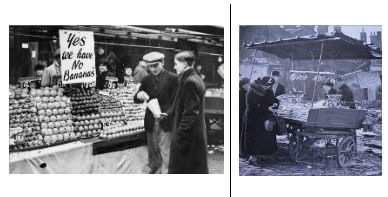
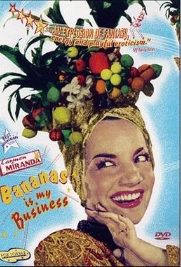
Lonon got
its first glimpse of the banana when herbalist, botanist and
merchant Thomas Johnson displayed a bunch in his shop in Snow
Hill, in the City of London, on April 10, 1633. He included the woodcut you see at the top of this article in his “very much enlarged” edition of John Gerard’s popular botanical encyclopaedia, The herbal or general histories of plants. 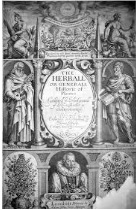
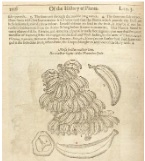 Johnson’s single stem of bananas came from the recently colonised island of Bermuda. We don’t know what variety it was – but these days the chances are that any banana you will find in a British supermarket will be descended from the Cavendish banana. This strain was developed in the 19th century by the head gardener at Chatsworth House, John Paxton. His invention is called the Cavendish, rather than the Paxton, after the family name of the owners of the Chatsworth estate, the Duke and Duchess of Devonshire. Paxton spent several years developing his banana. In 1835 his plant finally bore fruit, which won him a prize from the Royal Horticultural Society. The Cavendish slowly gained popularity as a cultigen, but its current dominance is the result of a calamity. The genetic uniformity of commercial banana plantations is a hostage to ill-fortune. During the 1950s a virulent fungal pathogen wiped out the previously ubiquitous Gros Michel variety. The Cavendish stepped into the space left by the attack of Panama Disease. There is no reason to assume the fate suffered by the Gros Michel will not befall the Cavendish. What then will adorn our bowls of cereal and add volume to our smoothies? |
|
March 2026
The River Thames Luncheon Club Friday 13th March 2026
Luncheon Menu |
The River Thames Luncheon Club Bookings |
Wines |
| Purple Broccoli &
Celeriac Soup Selection of Breads &&& Fillet of Atlantic Hake Early Seasoned New Forest Asparagus Risotto Safron Sauce &&& Medallion of English Rose County Veal Sage Jus Minted Jersey Royal Potatoes Glazed Baby Vegetables &&& Pistachio Crème Brulee Blackcurrant Sorbet &&& Norbury Blue Cheese Tart &&& Fair Trade Rich Roast Coffee Tregothnan Cornish Estate Grown Tea Chocolate Truffles |
Book this
Georgian Hall The Luncheon Club is an opportunity to promote the fabulous hospitality and historic setting of the Watermen's Hall. We would be delighted to hear from any of your friends or associated organizations for Meeting Luncheon Dinner Please email cookandbutler@btconnect.com to make event reservation or inquires |
Barão de Vilar White Port &&& Sauvignon Blanc IGP Pays d'Oc 2024 Domaine Bergon Vias Languedoc &&& Chianti Classic I Grotti 2016 Tuscany &&& Muskat Ottonel 2018 Late Harvest Spätlese &&& Barão de Vilar Port |
On this day 13th
March 1969 Apollo 9 splashed down 160 nautical miles east of the
Bahamas after a mission lasting 10 days, 1 hour, 54 seconds. 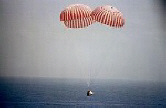
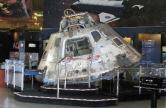 Apollo 9 was the third human spaceflight in NASA's Apollo program, which successfully tested systems and procedures critical to landing on the Moon. The three-man crew consisted of Commander James McDivitt, Command Module Pilot David Scott, and Lunar Module Pilot Rusty Schweickart. Flown in low Earth orbit, it was the second crewed Apollo mission that the United States launched via a Saturn V rocket, and was the first flight of the full Apollo spacecraft: the command and service module with the Lunar Module. The mission was flown to qualify the LM for lunar orbit operations in preparation for the first Moon landing by demonstrating its descent and ascent propulsion systems, showing that its crew could fly it independently, then rendezvous and dock with the CSM again, as would be required for the first crewed lunar landing. After launching on March 3, 1969, the crew performed the first crewed flight of an Apollo Lunar Module, the first docking and extraction of the same. Originally scheduled to launch on February 28, 1969, the liftoff of Apollo 9 was postponed because all three astronauts had colds, and NASA did not want to risk that the mission might be affected. Around-the-clock labour shifts were required to keep the spacecraft in readiness; the delay cost $500,000, the rocket launched from KSC at 11:00:00 EST on March 3. The crew began their first major orbital task with the separation of the CSM from the S-IVB at 02:41:16 into the mission, seeking to turn around and then dock with the LM, which was on the end of the S-IVB, after which the combined spacecraft would separate from the rocket. Celebrate The 57th Anniversary Of Apollo 9, Which Made The Moon Landing Possible 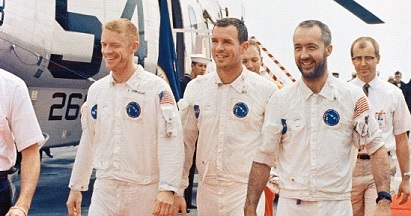 |
Apollo spacecraft configuration with
CSM and LM docked 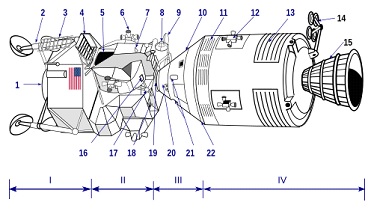 I - Lunar module descent stage; II - Lunar module ascent stage; III - Command module; IV - Service module.1 LM descent engine skirt; 2 LM landing gear; 3 LM ladder; 4 Egress platform; 5 Forward hatch; 6 LM reaction control system quad; 7 S- band inflight antenna (2); 8 Rendezvous radar antenna; 9 S-band steerable antenna; 10 Command Module crew compartment; 11 Electrical power system radiators; 12 SM reaction control system quad; 13 Environmental control system radiator; 14 S-band steerable. On March 7, the fifth day, came "the key event of the entire mission: the separation and rendezvous of the lunar module and the command module". The lunar module lacked the capability to return the astronauts to Earth, this was the first time space travellers had flown in a vehicle that could not take them home. McDivitt and Schweickart entered the LM early, having obtained permission to do so without wearing their helmets and gloves, making it easier to set up the LM. When Scott in Gumdrop pushed the button to release the LM, it initially hung on the latches at the end of the docking probe, but he hit the button again and Spider was released. After spending about 45 minutes near Gumdrop, Spider went into a slightly higher orbit, meaning that over time, the two craft would separate, with Gumdrop ahead. Then, McDivitt docked the craft. After McDivitt and Schweickart returned to Gumdrop, Spider was jettisoned, its engine fired remotely to fuel depletion by Mission Control as part of further testing of the engine, simulating an ascent stage & climb from the lunar surface. March 13th they raised Spider to an orbit with apogee of over 3,700 nautical miles. Apollo 9 was to remain in space for about ten days to check how the CSM would perform over the period of time required for a lunar mission. |
January 2026
The River Thames Luncheon Club Friday 9th January 2026
Luncheon Menu
Winter Kale & Root Vegetable Soup &&&
Roasted Fillet of Mullet &&&
Le Creuset Casserole of Balmoral Venison &&&
The Kings Epiphany Cake &&&
English Brie Rarebit &&&
Fair Trade Rich Roast Coffee
|
Wines
Barão de Vilar White Port &&& Cotes de Gascogne Colombard Sauvignon Blanc &&& Azania Pinotage 2020 &&& Gewürztraminer Late Harvest Spätlese 2021 &&& Barão de Vilar Port |
Dates 2025
Book this Fabulous Hall
The Luncheon Club is an opportunity to demonstrate the fabulous hospitality and historic setting of the Watermen's Hall. Please email cookandbutler@btconnect.com to make event reservations or inquiries. We would be delighted to hear from any of your friends or associated organizations.
Friday 9th
January 2026 – Fully Booked
Friday 13th March 2026 – Fully Booked
Friday 10th April 2026 – Fully Booked
Friday 8th May 2026 – Fully Booked No Luncheon August Friday 12th September – Fully Booked Friday 10th October – Fully Booked Friday 14th November – Fully Booked Friday 12th December – Fully Booked
Friday 12th June 2026
Friday 10th July 2026
No Luncheon August
Friday 11th September 2026 Friday 9th October 2026 – Fully Booked
Friday 13th November 2026 – Fully Booked Friday 11th December 2026 – Fully Booked
|
|
On this day 9th January 1799:
income tax introduced to Britain |
December 2025

The River Thames Luncheon Club Friday 12th December 2025
|
Luncheon Menu
Roasted Carrot & Swede Soup Selection of Breads &&& Christmas Rosettes of Scottish Salmon Marinated in Hymans of London Sloe Gin Lime Crème Fresh Samphire Salad &&&
Roast Breast of Goose & Confit of Leg Tarragon & Ginger Crust Rosemary Jus Chateau Potatoes Braised Red Cabbage & Baby Carrots &&&
The Cook & The Butler World Famous Traditional Christmas Pudding Christmas Pudding Ice Cream Oranges in Caramelised Oranges Rum Sauce &&&
Mature Stilton Cheese Rarebit on Granary Toast Topped with the Christmas Pigs in Blanket Corn Salad Washed in Truffle Oil &&&
Fair Trade Rich Roast Coffee Tregothnan Cornish Estate Grown Tea Chocolate Truffles |
Wines Reception
With Soup Barão de Vilar White Port &&&
With Fish
El Campo Sauvignon Blanc 2023 El Campo, Central Valley &&&
With Main
Tribal Dry Red 2021 Western Cape African Terroir South Africa&&&
With Dessert
Muskat Ottonel Late Harvest Spätlese 2018 Julius Hafner, Mönchhof, Neusiedlersee &&&
|
2025 Dates Book this Fabulous Hall
The Luncheon Club is opportunity to demonstrate the fabulous hospitality and historic setting of the
Watermens Hall. Please email cookandbutler@btconnect.com
to make event reservation or inquires. We would be delighted to hear from any of your friends or associated organizations.
2026 Dates Friday 9th January 2026 – Fully Booked Friday 13th February 2026 - Fully Booked Friday 13th March 2026 – Fully Booked Friday 10th April 2026 – Fully Booked Friday 12th June 2026 Friday 10th July 2026
No Luncheon August
Friday 11th September 2026 Friday 9th October 2026 – Fully Booked Friday 13th November 2026 – Fully Booked Friday 11th December 2026 – Fully Booked
|
|
John Taylor - The Watermens Poet Born in the parish of St. Ewen's, near South Gate, Gloucester on 24 August 1578. In the early 1590s, after his attempt at grammar school he moved from his home to south London, probably Southwark, to begin an apprenticeship as a waterman. His occupation was one deemed unpopular by the literary elite of London. Watermen were known to be drunkards, and often gossips and liars, who attempted to cheat patrons into a higher wage for their service. This occupation would be crafted into an image for Taylor later in his career. He spent much of his life as a Thames waterman, a member of the guild of boatmen that ferried passengers across the River Thames in London, in the days when the London Bridge was the only passage between the banks. His occupation was his gateway into the literary society of London, as he ferried patrons, actors, and playwrights across the Thames to the Bankside theatres. In 1620, Taylor claimed almost 20,000 men lived by this trade, including dependents and servants, and in 1641, he believed there were over 40,000 in the company itself He became a member of the ruling oligarchy of the guild, serving as its clerk; Taylor discusses the watermen's disputes with the theatre companies who moved the theatres from the south bank to the north in 1612, The move of theatres from the south bank to the north took a huge toll on Taylor's income, and despite at that time being in the company of the King's Watermen, he could not sway the king to prevent the move. Taylor was also the first poet to mention the deaths of William Shakespeare and Francis Beaumont in print, in his 1620 poem, "The Praise of Hemp-seed". Both had died four years earlier. He was a prolific poet, with over one hundred and fifty publications in his lifetime. Although his work was not sophisticated, he was a keen observer of people and styles in the seventeenth century, and his work is often studied by social historians. Taylor died in London in December 1653 aged 75. He was buried on 5 December at the church of St Martin-in-the-Fields. “He entertained no gout, no ache he felt,The air was good and temperate where he dwelt; While mavisses and sweet-tongued nightingales Did chant him roundelays and madrigals. Thus living within bounds of nature's laws, Of his long-lasting life may be some cause”
|
Christmas 2024 is the 377th anniversary of the Plum Pudding Riots that followed Parliament’s clamp down on Christmas in 1647,In 1644, the Puritans gained control of Parliament. With Grinch-like fervour they set about cancelling Christmas. At a stroke, the traditional 12-day festival – a prolonged period of merriment and revelry characterised by rich food, dancing and excess – was banned.The Puritans regarded Christmas celebrations as sinful, ‘giving liberty to carnal and sensual delights’. Even worse, the traditional decorations of holly, ivy, rosemary and bays were pagan.To bring the country to its senses – or its knees – Christmas Day was initiallyturned into a day of fasting and repentance until, in June 1647, it was abolished altogether.
John Taylor created the idea of Father Christmas and the Man who saved Christmas“Let’s dance and sing and make good cheer, since Christmas comes back once a year” John TaylorIn his pamphlet The Vindication of Christmas written in 1652 stood up to the Puritan assault on Christmas tradition. The cover of John Taylor’s pamphlet personified Christmas and championed the customs of the common man against what Taylor felt were the beliefs of a minority - The world upside down“All the liberty and harmless sports, with the merry gambols, dances and friscals [by] which the toiling plowswain and labourer were wont to be recreated and their spirits and hopes revived for a whole twelve month are now extinct and put out of use in such a fashion as if they never had been. Thus are the merry lords of misrule suppressed by the mad lords of bad rule at Westminster” |

November 2025
The River Thames Luncheon Club Friday 14th November 2025
|
Luncheon Menu
Celery & Apple Soup Selection of Breads &&&
Fillet of Black Bream Parsnip Puree Coriander Sauce &&&
A Creuset Dish of " Poilus Trench Casserole" Wild Boar Cranberry Wild Mushroom King Edwards Potatoes & Root Vegetables &&&
The Old Contemptible British Expeditionary Force Crumble of Plum & Blackberry Crumble Classic English Custard Sauce Clotted Cream Ice Cream &&&
Mature Tommy Atkins Cheddar & The Trench Cookhouse Pickles Corn Salad Washed in Truffle Oil &&&
Fair Trade Rich Roast Coffee Tregothnan Cornish Estate Grown Tea Chocolate Truffles |
Wines Reception
With Soup Barão de Vilar White Port &&&
With Fish
Azania Chenin Blanc 2023 Western Cape African Terroir &&&
With Main
Carignan Vieilles Vignes 2024 Roche de Belanne &&&
With Dessert
Muskat Ottonel Late Harvest Spätlese 2018 Julius Hafner, Mönchhof, Neusiedlersee &&&
|
2025 Dates Book this Fabulous Hall
The Luncheon Club is opportunity to demonstrate the fabulous hospitality and historic setting of the
Watermens Hall. Please email cookandbutler@btconnect.com
to make event reservation or inquires. We would be delighted to hear from any of your friends or associated organizations.
2026 Dates Friday 9th January 2026 – Fully Booked Friday 13th February 2026 - Fully Booked Friday 13th March 2026 – Fully Booked Friday 10th April 2026 – Fully Booked Friday 8th May 2026 Friday 12th June 2026 Friday 10th July 2026
No Luncheon August Friday 11th September 2026 Friday 9th October 2026 – Fully Booked
Friday 13th November 2026 Friday 11th December 2026 – Fully Booked
|
|
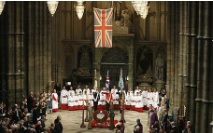
The Reverend David Railton MC (13 November 1884 – 30 June 1955) was a Church of England clergyman, a military chaplain and the originator of the idea of the Tomb of The Unknown Warrior in Britain. World War I In 1910, he moved to Ashford, Kent, and in the following year became temporary chaplain to the Forces. He was curate of Folkestone in 1914–20, but had leave of absence to serve in France. He was awarded the Military Cross in 1916 for saving an officer and two men under heavy fire. Railton first had the idea of arranging for the body of an unknown serviceman to be transported back to England, and buried with full honours, in 1916, while he was serving on the Western Front during World War I. In 1916 Railton was an experienced and mature man in his thirties and was appalled at the sufferings and loss caused by the War. Later in the war he wrote to Sir Douglas Haig expressing this idea. He received no response, but felt reluctant to let it go. The Unknown Warrior After the War Railton became the vicar of St. John the Baptist Church at Margate, but he still hoped to impress the authorities with his idea. In August, 1920 he wrote to Bishop Ryle, the Dean of Westminster, about the possibility of giving an unidentified soldier a national burial service in Westminster Abbey. Ryle took up the idea and his and Lloyd George's enthusiasm won over the initially hesitant King George V. In October 1920 Railton heard that his idea had been accepted by the Government. A committee headed by Lord Curzon, the then Foreign Secretary, was arranging for an unknown "warrior" to be disinterred in France and brought to Westminster Abbey. On 7th November 1920 six, or according to other accounts four, working parties visited the battlefields of Ypres, the Marne, Cambrai, Arras, the Somme, and the Aisne, where units of the Royal Naval division as well as the Army had died: each party exhumed an unidentified body which was examined to ensure that it was British before being placed in a plain coffin. At midnight one of these coffins was chosen by Brigadier General L. J. Wyatt, General Officer Commanding troops in France and Flanders, and thus became the official "Unknown Warrior", placed in a new coffin bearing the inscription "A British Warrior who fell in the Great War 1914–1918 for King and Country". |
He later tried to explain why he had felt it was so important to commemorate the individual in this way. He recalled an incident near Armentières where he came across a grave with a rough wooden cross inscribed "An unknown British soldier, of the Black Watch": How that grave caused me to think!... But, who was he, and who were they [his folk]?... Was he just a laddie... . There was no answer to those questions, nor has there ever been yet. So I thought and thought and wrestled in thought. What can I do to ease the pain of father, mother, brother, sister, sweetheart, wife and friend? Quietly and gradually there came out of the mist of thought this answer clear and strong, "Let this body – this symbol of him – be carried reverently over the sea to his native land". And I was happy for about five or ten minutes The "Padre's flag," the Union Flag used by Reverend David Railton as an altar cloth and shroud during World War I Draping the coffin. On Armistice Day, November 11, 1920, the flag covered the coffin of the Unknown Warrior as it made its final journey through London to the Abbey. The flag hung above the tomb for 30 years but was moved to a side chapel in the 1950s due to fears it was deteriorating. The flag was reinstated above the tomb on November 11, 2009, to mark a significant moment in history—the passing of the last generation of World War I survivors. A poignant tribute: The service was attended by The Queen, the Duke of Edinburgh, senior politicians, and heads of the armed forces, making the return of the flag a focal point of the memorial ceremony. The Padre's Flag Today The flag still hangs in Westminster Abbey today, close to the Tomb of the Unknown Warrior, serving as a poignant symbol of the conflict and the sacrifices made during the Great War.
|
October 2025
The River Thames Luncheon Club Friday 10th October 2025
|
Luncheon Menu
Celery & Apple Soup Selection of Breads &&&
Monkfish & Green Spinach Risotto Smoked Red Pepper Drizzle &&&
The Smithfield Market Porter Beef Steak Pan Juice Gravy Flavoured with Horseradish Old Fashioned Roasted King Edwards Potatoes in Duck Fat Cauliflower Mornay Baby Carrots &&&
Warm Orange & Chocolate Tart Lemon Grass Crème Anglaise White Chocolate Ice Cream &&&
Wallace & Gromit - The Curse of the Were-Rabbit Stinking Bishop Cheese on Toast &&&
Fair Trade Rich Roast Coffee Tregothnan Cornish Estate Grown Tea Chocolate Truffles
|
Wines
Reception
With Soup Barão de Vilar White Port &&&
With Fish
Comte Tolosan IGP Le Pionnier Blanc 2024 South West - Gascogne &&&
With Main Merlot 2023 Les Prunelles IGP Pays d'Oc SAS Bruno Andreu Montblanc Languedoc &&&
With Dessert
Muskat Ottonel Late Harvest Spätlese 2018 Julius Hafner, Mönchhof, Neusiedlersee &&&
|
2025 Dates
Friday 14th November – Fully Booked Friday 12th December – Fully BookedBook this Fabulous Hall
The Luncheon Club is opportunity to demonstrate the fabulous hospitality and historic setting of the
Watermens Hall. Please email cookandbutler@btconnect.com
to make event reservation or inquires. We would be delighted to hear from any of your friends or associated organizations.
2026 Dates Friday 9th January 2026 Friday 13th February 2026 Friday 13th March 2026 Friday 10th April 2026 Friday 8th May 2026 Friday 12th June 2026 Friday 10th July 2026No Luncheon August Friday 11th September 2026 Friday 9th October 2026 – Fully Booked Friday 13th November 2026 Friday 11th December 2026
|
|
On this day 10th October 1903 The Women's Social and Political Union (WSPU) was founded by Emmeline Pankhurst and her daughters in Manchester, England, with the aim of advocating for women's suffrage. This organization emerged in response to the insufficient progress made by existing suffrage groups, which had primarily employed traditional political methods. The WSPU distinguished itself by adopting more militant tactics, including protests, hunger strikes, and civil disobedience, to draw attention to women's rights and the fight for the vote. The WSPU's early activities highlighted the exclusion of women from political discourse and sought to redefine the narrative around women's capabilities. Despite initial successes in garnering public attention, their methods eventually alienated some potential supporters, leading to complex reactions from the political establishment. The outbreak of World War I prompted a shift in focus, as many suffragists contributed to the war effort, which ultimately influenced the granting of limited voting rights to women in 1918. The significance of the WSPU lies not only in its contribution to women's suffrage but also in its role in challenging societal stereotypes regarding women. This movement marked a notable shift in political activism in Great Britain and helped pave the way for future advancements in women's rights, culminating in the eventual achievement of equal voting rights in 1928. Little is known of the early meetings of the WSPU, as records of minutes, strategies, finances, and membership no longer exist. Two facts are clear: Men were excluded from membership, and the WSPU had a clear platform. A WSPU pamphlet dated December, 1903, stated that “for all purposes connected with, and having reference to, the right to vote at Parliamentary elections, words in the Representation of the People Act importing the masculine gender shall include women.” Simply translated, universal manhood suffrage should be understood to mean universal personhood suffrage. The statement of purpose by the WSPU was not new, but the group’s method of attracting attention to the issue was. |
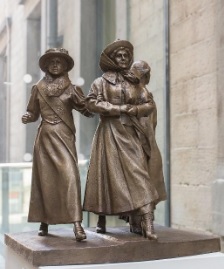 Prior to the WSPU, women’s suffrage groups had not only followed the unwritten rules of political activism but had also remained true to the stereotype of women. The Pankhursts observed that following the rules had achieved nothing. Over the next decade, the WSPU utilized every traditional and nontraditional tactic available. In addition to making speeches, holding rallies, and distributing printed materials, WSPU suffragists made press headlines by heckling and taunting politicians wherever possible. Despite the members’ efforts, the WSPU’s actions did far more to alienate potential supporters than they did to gain support for woman suffrage. The government considered suffragists to be primarily an irritant and not a major problem. The outbreak of war in August, 1914, changed everything. Emmeline Pankhurst called an immediate halt to militancy, and the government released women suffragists from prison. Throughout World War I the WSPU, the National Union of Women's Suffrage Societies, and other women’s suffrage organizations worked for the war effort. Women filled traditional men’s occupations, thereby freeing men for the trenches. Largely because of women’s contributions to the war effort, limited suffrage was granted to women in Great Britain in February, 1918. Voting equality was finally achieved with the Representation of the People Act of 1928. |
September 2025
The River Thames Luncheon Club Friday 12th September 2025
|
Luncheon Menu
Wild Mushroom Soup Philadelphia Cheese Crout Selection of Breads &&&
Warm Smoked Halibut & Cod Parfait Spinach Puree Coriander Sauce &&&
Boned & Rolled Loin of Suckling Pig Caraway Seed Sauce Boulangère Potatoes Red Wine Sauce Roast Green Apple & White Cabbage &&&
Houston Blueberry & Vanilla Cheese Cake Cherry Ice Cream
Grilled Cornish Yarg Cheese on Granary Croute Rocket Salad & Malted Vinegar Dressing &&&
Fair Trade Rich Roast Coffee Tregothnan Cornish Estate Grown Tea Chocolate Truffles
|
Wines
Reception Touraine Brut Rosé Antoine Simoneau Anjou – Touraine
With Soup Barão de Vilar White Port &&&
With Fish Azania Chenin Blanc 2023 Western Cape African Terroir &&&
With Main Azania Pinotage 2020 Western Cape African Terroir &&&
With Dessert Muskat Ottonel Late Harvest Spätlese 2018 Julius Hafner, Mönchhof, Neusiedlersee
&&&
|
2025 Dates
Friday 10th October – Fully Booked
Friday 14th November – Fully Booked Friday 12th December – Fully Booked
Book this Fabulous Hall
The Luncheon Club is opportunity to demonstrate the fabulous hospitality and historic setting of the
Watermens Hall. Please email cookandbutler@btconnect.com
to make event reservation or inquires. We would be delighted to hear from any of your friends or associated organizations.
|
|
On 12th September 1962 a warm and sunny day, President John F Kennedy delivered his speech before a crowd of about 40,000 people, at Rice University's Rice Stadium. “We meet at a college noted for knowledge, in a city noted for progress, in a state noted for strength, and we stand in need of all three, for we meet in an hour of change and challenge, in a decade of hope and fear, in an age of both knowledge and ignorance. The greater our knowledge increases, the greater our ignorance unfolds” The aim was to bolster public support for his proposal to land a man on the Moon. Largely written by presidential advisor and Speechwriter Ted Sorensen. In his speech, Kennedy characterized space as a new frontier, invoking the pioneer spirit that dominated American folklore. He infused the speech with a sense of urgency and destiny, and emphasized the freedom enjoyed by Americans to choose their destiny rather than have it chosen for them. The speech resonated widely, although there was disquiet about the cost and value of the Moon-landing effort. Kennedy's goal was realized posthumously, on July 20, 1969, with the Apollo program's successful Apollo 11 mission. The middle portion of the speech has been widely quoted: We set sail on this new sea because there is new knowledge to be gained, and new rights to be won, and they must be won and used for the progress of all people. For space science, like nuclear science and all technology, has no conscience of its own. Whether it will become a force for good or ill depends on man, and only if the United States occupies a position of pre-eminence can we help decide whether this new ocean will be a sea of peace or a new terrifying theatre of war. I do not say that we should or will go unprotected against the hostile misuse of space any more than we go unprotected against the hostile use of land or sea, but I do say that space can be explored and mastered without feeding the fires of war. |
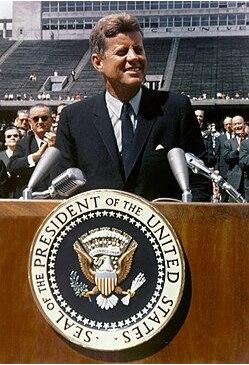 without repeating the mistakes that man has made in extending his writ around this globe of ours. There is no strife, no prejudice, no national conflict in outer space as yet. Its hazards are hostile to us all. Its conquest deserves the best of all mankind, and its opportunity for peaceful cooperation may never come again. But why, some say, the Moon? Why choose this as our goal? And they may well ask, why climb the highest mountain? Why, 35 years ago, fly the Atlantic? Why does Rice play Texas? We choose to go to the Moon. We choose to go to the Moon... We choose to go to the Moon in this decade and do the other things, not because they are easy, but because they are hard; because that goal will serve to organize and measure the best of our energies and skills, because that challenge is one that we are willing to accept, one we are unwilling to postpone, and one we intend to win, and the others, too. www.youtube.com/watch?v=WZyRbnpGyzQ and they did 16th July 1969 |
May 2025
The River Thames Luncheon Club Friday 9th May 2025
|
Luncheon Menu Sweet Potato & Basil Soup Toasted Brioche
Baked Atlantic Cod Grilled English Asparagus Flat Parsley Drizzle
Cannon OF Lancashire Grass Fed Lamb Red Currant Jus Minted Jersey Royal Potatoes Glazed Baby Vegetables
Early Season Soft Fruit Parfait Mango Sorbet
Gubbeen Rarebit Rocket Salad
Fair Trade Rich Roast Coffee Tregothnan Cornish Estate Grown Tea Chocolate Truffles
|
Wines Barão de Vilar White Port
El Zafiro 2023 Pardina/Chardonnay Vinaoliva Extremadura Spain Pardina (80%) Chardonnay (20%)
Cabernet Merlot Fleurs de Terre 2023 Les Vignobles Foncalieu Languedoc- Roussillon Cabernet Sauvignon (50%) Merlot (50%) &&&
Muskat Ottonel Late Harvest Spätlese 2018 Julius Hafner, Mönchhof, Neusiedlersee Austria &&&
Barão de Vilar Port
|
2025 Dates Friday 13th June – Fully Booked Friday 11th July – Fully Booked
No Luncheon August
Friday 12th September – Fully Booked
Friday 10th October – Fully Booked
Friday 14th November – Fully Booked Friday 12th December – Fully Booked
Book this Fabulous Hall
The Luncheon Club is opportunity to demonstrate the fabulous hospitality and historic setting of the
Watermens Hall. Please email cookandbutler@btconnect.com
to make event reservation or inquires. We would be delighted to hear from any of your friends or associated organizations.
|
|
Botched Crown Jewels Theft Pays Off - Thomas Blood – from villain to King's confidante 9th May 1671 — Thomas Blood tried to steal the Crown Jewels from the Tower of London on this day. At various times Blood – who called himself either “Captain” or “Colonel” – was an adventurer, a rebel, a master of disguise, a con-man and a spy – but, by all accounts, a likeable rogue. Born in Ireland in 1618, the son of a blacksmith, he came to England to fight for King Charles I when the English Civil War broke out in 1642. But when it became apparent that Oliver Cromwell was going to win, he promptly changed sides and joined the Parliamentarians. He was granted land in Ireland for his services.1671 Blood settled on a new plan to both strike it rich and to strike a blow at the monarchy: he would steal the Crown Jewels. Disguised as a clergyman, he became friendly with the newly appointed Master of the Jewel House at the Tower of London, 77-year-old Talbot Edwards, and made a number of calls on him. Over the following days Blood returned to the Tower to visit the Edwardses and presented Mrs Edwards with four pairs of white gloves as a gesture of thanks. As Blood became ingratiated with the family, an offer was made for a fictitious nephew of Blood's to marry the Edwardses' daughter, who, Blood alleged, would be eligible, by virtue of the marriage, to an income of several hundred pounds.
On 9 May 1671, in furtherance of the deception, Blood convinced Edwards to show the jewels to him, his supposed nephew, and two of his friends while they waited for a dinner that Mrs Edwards was to put on for Blood and his companions. The jewel keeper's apartment was in Martin Tower above a basement where the jewels were kept behind a metal grille. Reports suggest that Blood's accomplices carried canes that concealed rapier blades, daggers, and pocket pistols. In entering the Jewel House, one of the men made a pretence of standing watch outside while the others joined Edwards and Blood. The door was closed and a cloak thrown over Edwards, who was struck with a mallet, knocked to the floor, bound, gagged and stabbed to subdue him. After removing the grille, Blood used the mallet to flatten the Imperial State Crown so that he could hide it beneath his clerical coat. Another conspirator, Blood's brother-in-law Hunt, filed the Sceptre with the Cross in two (as it did not fit in their bag), while the third man, Perrot, stuffed the Sovereign's Orb down his breeches. Meanwhile Edwards refused to stay subdued and fought against his bindings. Accounts vary as to whether Edwards' struggle caused sufficient disturbance to raise the alarm or whether the attempt was foiled in more fortuitous circumstances.
Popular reports describe Edwards' son, Wythe, returning from military service in Flanders, happening upon the attempted theft. At the door of the Jewel House, Wythe was met by the impromptu guard, who challenged him, before the young Edwards entered and went upstairs. The "guard" then alerted his fellow gang members. At around the same time, the elder Edwards managed to free his gag, and raised the alarm shouting, "Treason! Murder! The crown is stolen!" As Blood and his gang fled to their horses waiting at St Catherine's Gate, they dropped the sceptre and fired on the warders who attempted to stop them, wounding one. One drawbridge guard was struck with fear and failed to discharge his musket. As they ran along the Tower wharf it is said they joined the calls for alarm to confuse the guards until they were chased down by Captain Beckman, brother-in-law of the younger Edwards. Although Blood shot at him, he missed and was captured before reaching the Iron Gate. Having fallen from his cloak, the crown was found while Blood refused to give up, struggling with his captors and declaring, "It was a gallant attempt, however unsuccessful! It was for a crown!" The globe and orb were recovered although several stones were missing and others were loose. Hunt and Perrot were also taken, but not punished. |
April 2025
The River Thames Luncheon Club Friday 11th April 2025
Luncheon MenuCream of Barley Soup Selection of Breads
&&&
Poached Scottish Salmon Watercress Puree Hollandaise Sauce
&&&
Cannon of Lancashire Grass Fed Lamb Garden Herb Crust Thyme Jus Jersey Royal Potatoes Roasted Spring Harvest Vegetables
&&&
White Cookies Ice Cream
&&&
Waldorf & Stilton Cheese Savoury Apples Celery White Grapes Walnuts
&&&
Fair Trade Rich Roast Coffee Tregothnan Cornish Estate Grown Tea Chocolate Truffles
|
WinesBarão de Vilar White Port
&&&
Boatmans Drift Chenin Blanc Western Cape South Africa
&&&
Merlot Ca` Luca IGT Trevenezie 2023 Casa Vinicola Botter spa Veneto Italy
&&&
Gewürztraminer Late Harvest Spätlese 2021 Julius Hafner, Mönchhof, Neusiedlersee Austria
&&&
Barão de Vilar Port
|
2025 DatesFriday 9th
May – Fully Booked
|
| Friday 11th April
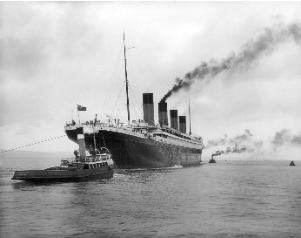
on this day 1912 Royal Mail Ship Titanic slipped anchor to sail
on her maiden voyage, a return trip from Britain to America.
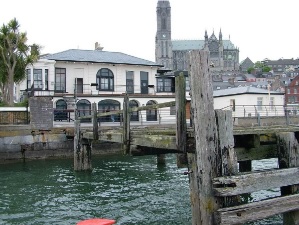
Her last stop was Queenstown, Ireland. The intended distance of 2,825 miles the longest leg of the voyage. 137 hours the anticipated journey time sailing. 11:30 am the time Titanic dropped anchor in Queenstown, on the morning of 11th of April 1912, about 2 miles offshore. 7 passengers disembarked in Ireland. 123 passengers boarded at Queenstown 3 first-class, 7 second-class and 113 third-class ticket-holders. 63 male passengers 60 female passengers who came aboard.Transported by 2 tenders that ferried the passengers from Heartbreak Jetty to Titanic; they were named PS Ireland and PS America. 1,385 bags of mail delivered on board during the Queenstown stop. At 1.30pm Titanic raised anchor and set sail on her first and last transatlantic crossing. There were 2,223 people aboard Titanic for her maiden trip, 1,324 passengers and 908 crew. The average cost for a First Class berth £30. A parlour suite would have set you back the princelier sum of £875. The average cost of a berth in Standard (Second) Class was £12. The average cost of a Steerage (Third) Class berth was £3-£8. |
Titanic raised anchor and set sail 11th April 1912
White Star Line Office Cobh-Queenstown, Ireland. |
|
|
March 2025
The River Thames Luncheon Club Friday 14th March 2025
Luncheon Menu
Red Lentil & Kale Soup Selection of Breads &&& Billingsgate Porter Pan Fried Fish Cake Light Curry Sauce Samphire Sauce Selection of Breads &&& Cannon of Blackfaced Sussex Lamb Forest Berry Sauce Fondant Potatoes Fennel & Spring Onion &&& Peruvian Coffee Crème Brulee White Chocolate Ice Cream Sailor Jerry Spiced Jamaican Rum Crème Anglaise &&& Red Leicester & Mature Cheddar with Smoked Onion Wrapped in Puff Pastry Pie Salad of Leaves &&& Fair Trade Rich Roast Coffee Tregothnan Cornish Estate Grown Tea Chocolate Truffles
|
Wines
Barão de
Vilar White Port
|
2025 DatesFriday 9th
May – Fully Booked
|
|
Pi Day 14th March Pi Day is an annual celebration of the mathematical constant π (pi). Pi Day is observed on March 14 (the 3rd month) since 3, 1, and 4 are the first three significant figures of π, and was first celebrated in the United States. It was founded in 1988 by Larry Shaw, an employee of a science museum in San Francisco, the Exploratorium. Celebrations often involve eating pie or holding pi ecitation competitions.
In 2009, the United States House of Representatives supported the designation of Pi Day. UNESCO's 40th General Conference designated Pi Day as the International Day of Mathematics in November 2019. Other dates when people celebrate pi include Pi Approximation Day on July 22 (22/7 in the day/month format, an approximation of π) and June 28 (6.28, an approximation of 2π or tau).HistoryIn 1988, the earliest known official or large-scale celebration of Pi Day was organized by Larry Shaw at the San Francisco Exploratorium, where Shaw worked as a physicist, with staff and public marching around one of its circular spaces, then consuming fruit pies.
The Exploratorium continues to hold Pi Day celebrations. On March 12, 2009, the U.S. House of Representatives passed a non-binding resolution (111 H. Res. 224), recognizing March 14, 2009, as National Pi Day. For Pi Day 2010, Google presented a Google Doodle celebrating the holiday, with the word Google laid over images of circles and pi symbols; and for the 30th anniversary in 2018, it was a Dominique Ansel pie with the circumference divided by its diameter. Some observed the entire month of March 2014 (3/14) as "Pi Month". In the year 2015, March 14 was celebrated as "Super Pi Day". It had special significance, as the date is written as 3/14/15 in month/day/year format. At 9:26:53, the date and time together represented the first ten digits of π, and later that second, "Pi Instant" represented all of π's digits.
Observance.Pi Day related offering at Delicious
Orchards,
a country food market in Colts
Neck, New Jersey
Pi Day has been observed in many ways, including eating pie, throwing
pies and
discussing the significance of the number π, due to a pun based
on the words "pi" and "pie" being homophones in
English ( /paɪ/),
and the coincidental circular shape of many pies. Many pizza and
pie restaurants offer discounts, deals, and free products on
Pi Day. Also, some schools hold competitions as to which
student can recall
pi to the highest number of decimal places.
|
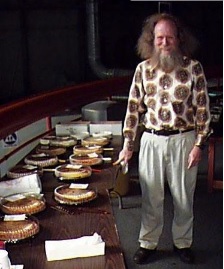 Larry Shaw, the organizer of the first Pi Day celebration, at the Exploratorium in San Francisco ___________________________________ Many pizza and pie restaurants offer discounts, deals, and free products on Pi Day. Also, some schools hold competitions as to which student can recall pi to the highest number of decimal places
The Massachusetts Institute of Technology has often mailed its application decision letters to prospective students for delivery on Pi Day. Starting in 2012, MIT has announced it will post those decisions (privately) online on Pi Day at exactly 6:28 pm, which they have called "Tau Time", to honor the rival numbers pi and tau equally. In 2015, the regular decisions were put online at 9:26 am, following that year's "pi minute", and in 2020, regular decisions were released at 1:59 pm, making the first six digits of pi.
Princeton, New Jersey, hosts numerous events in a combined celebration of Pi Day and Albert Einstein's birthday, which is also March 14. Einstein lived in Princeton for more than twenty years while working at the Institute for Advanced Study. In addition to pie eating and recitation contests, there is an annual Einstein look-alike contest.
In 2024, the recreational
mathematician Matt
Parker and
a team of hundreds of volunteers at City
of London School spent
six days calculating 139 correct digits of pi by hand, in
what Parker claimed was "the biggest hand calculation in a
century".
On 15 August 2024, the main-belt
asteroid 314159
Mattparker[a] was
named in his honor. The citation highlights Parker's
biennial "Pi Day challenges", stating that they have helped
to popularize mathematics.
|
February 2025
The River Thames Luncheon Club Friday 14 th February 2025
|
Menu
RMS Titanic Inspired Luncheon Menu
Velvet Risotto
Noisette of Salt Mash Lamb
Duo of English & French Cheese “Yin & Yang”
Fair Trade Rich Roast Coffee
|
Wines Barão de Vilar White Port |
Dates 2025
Friday 9 th May – Fully Booked Friday 13 th June – Fully Booked Friday 11 th July – Fully Booked No Luncheon August Friday 12 th September – Fully Booked Friday 10 th October – Fully Booked Friday 14 th November – Fully Booked Friday 12 th December – Fully Booked Book this Fabulous Hall The Luncheon Club is opportunity to demonstrate the fabulous hospitality and historic setting of the Watermens Hall. Please email cookandbutler@btconnect.com to make event reservation or inquires. We would be delighted to hear from any of your friends or associated organizations. Past Menus on www.thecokkandthebutler.co.uk
|
|
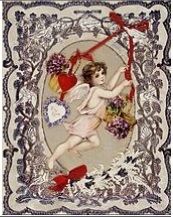
Valentine's Day,
also called Saint Valentine's Day or the Feast of Saint Valentine, is celebrated annually on February 14. It originated as a Christian feast day honouring a martyr named Valentine, and through later folk traditions it has also become a significant cultural, religious and commercial celebration of romance and love in many regions of the world |
 |
|
Folk traditions
While the European folk traditions connected with Saint Valentine and Saint Valentine's Day have become marginalized by modern customs connecting the day with romantic love, there are still some connections with the advent of spring. |
Valentine's Day is mentioned ruefully by Ophelia in William Shakespeare's Hamlet (1600–1601):
"To-morrow is Saint Valentine's day, — William Shakespeare, Hamlet, Act IV, Scene 5 |
|
Chaucer's Parliament of Fowls The first recorded association of Valentine's Day with romantic love is believed to be in the Parliament of Fowls (1382) by Geoffrey Chaucer, a dream vision portraying a parliament for birds to choose their mates. Honouring the first anniversary of the engagement of fifteen-year-old King Richard II of England to fifteen-year-old Anne of Bohemia, Chaucer wrote. In modern English: "For this was on Saint Valentine's DayWhen every bird comes there to choose his match. Of every kind that men may think of and that so huge a noise they began to make That earth and air and tree and every lake Was so full, that not easily was there space For me to stand—so full was all the place." |
The modern cliché Valentine's Day poem can be found in Gammer Gurton's Garland (1784), a collection of English nursery rhymes published in London by Joseph Johnson: "The rose is red, the violet's blue,
The honey's sweet, and so are you. And Fortune said it shou'd be you
|

December 2024
The River Thames Luncheon Club
The Watermens
Hall,
City of London EC3R 8EF
Friday 13th December 2024
|
Menu
Roasted Parsnip Soup
Christmas Spiced London Gin Cured Fillet of Smoked Scottish Salmon Lime Crème Fresh Samphire Salad
Roast Breast of Goose & Confit of Leg
Christmas Pudding Christmas Pudding Ice Cream Oranges in Caramelised Oranges Rum Sauce
Mature Stilton Cheese Rarebit on Granary Toast
Fair Trade Rich Roast Coffee |
Wines Hayman’s Master Award Winning |
Dates 2025 Friday 10 th January Friday 23rd – Fully Booked Friday 14 th March – Fully Booked Friday 11 th April – Fully Booked Friday 24th May Friday 13 th June – Fully Booked Friday 11 th July No Luncheon August Friday 12 th September Friday 10 th October Friday 14 th November Friday 12 th December – Fully Booked Past Menus on www.thecokkandthebutler.co.uk
Book this Fabulous Hall
|
|
John Taylor - The Watermens Poet Born in the parish of St. Ewen's, near South Gate, Gloucester on 24 August 1578. In the early 1590s, after his attempt at grammar school he moved from his home to south London, probably Southwark, to begin an apprenticeship as a waterman. His occupation was one deemed unpopular by the literary elite of London. Watermen were known to be drunkards, and often gossips and liars, who attempted to cheat patrons into a higher wage for their service. This occupation would be crafted into an image for Taylor later in his career. He spent much of his life as a Thames waterman, a member of the guild of boatmen that ferried passengers across the River Thames in London, in the days when the London Bridge was the only passage between the banks. His occupation was his gateway into the literary society of London, as he ferried patrons, actors, and playwrights across the Thames to the Bankside theatres. In 1620, Taylor claimed almost 20,000 men lived by this trade, including dependents and servants, and in 1641, he believed there were over 40,000 in the company itself He became a member of the ruling oligarchy of the guild, serving as its clerk; Taylor discusses the watermen's disputes with the theatre companies who moved the theatres from the south bank to the north in 1612, The move of theatres from the south bank to the north took a huge toll on Taylor's income, and despite at that time being in the company of the King's Watermen, he could not sway the king to prevent the move. Taylor was also the first poet to mention the deaths of William Shakespeare and Francis Beaumont in print, in his 1620 poem, "The Praise of Hemp-seed". Both had died four years earlier. He was a prolific poet, with over one hundred and fifty publications in his lifetime. Although his work was not sophisticated, he was a keen observer of people and styles in the seventeenth century, and his work is often studied by social historians. Taylor died in London in December 1653 aged 75. He was buried on 5 December at the church of St Martin-in-the-Fields. “He entertained no gout, no ache he felt, The air was good and temperate where he dwelt; While mavisses and sweet-tongued nightingales Did chant him roundelays and madrigals. |
Christmas 2024 is the 377th anniversary of the Plum Pudding Riots that followed Parliament’s clamp down on Christmas in 1647, In 1644, the Puritans gained control of Parliament. With Grinch-like fervour they set about cancelling Christmas. At a stroke, the traditional 12-day festival – a prolonged period of merriment and revelry characterised by rich food, dancing and excess – was banned. The Puritans regarded Christmas celebrations as sinful, ‘giving liberty to carnal and sensual delights’. Even worse, the traditional decorations of holly, ivy, rosemary and bays were pagan. To bring the country to its senses – or its knees – Christmas Day was initially turned into a day of fasting and repentance until, in June 1647, it was abolished altogether. 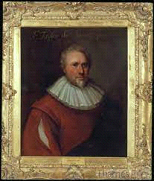 John Taylor created the idea of Father Christmas and the Man who saved Christmas “Let’s dance and sing and make good cheer, since Christmas comes back once a year” John Taylor In his pamphlet The Vindication of Christmas written in 1652 stood up to the Puritan assault on Christmas tradition. The cover of John Taylor’s pamphlet personified Christmas and championed the customs of the common man against what Taylor felt were the beliefs of a minority - The world upside down “All the liberty and harmless sports, with the merry gambols, dances and friscals [by] which the toiling plowswain and labourer were wont to be recreated and their spirits and hopes revived for a whole twelve month are now extinct and put out of use in such a fashion as if they never had been. Thus are the merry lords of misrule suppressed by the mad lords of bad rule at Westminster” |
November 2024
The River Thames Luncheon Club
The Watermens
Hall,
City of London EC3R 8EF
November 2024
|
Menu
Friday 8th November 2024 |
Wines
Barão de Vilar White Port
&&&
|
Dates 2024
January - Fully Booked Past Menus on www.thecokkandthebutler.co.uk
|
October 2024
The River Thames Luncheon Club
The Watermens
Hall,
City of London EC3R 8EF
October 2024
|
Menu
|
Wines
Barão de Vilar White Port
&&&
|
Dates 2024
January - Fully Booked Past Menus on www.thecokkandthebutler.co.uk
|
|
The Battle
of Camperdown was
a major naval action fought on 11 October 1797 between
the British
North Sea Fleet under Admiral Adam
Duncan and a Batavian
Navy (Dutch) fleet under Vice-Admiral Jan
de Winter. The battle, the most
significant action between British and Dutch forces during the French
Revolutionary Wars, resulted in a
complete victory for the British, who captured eleven Dutch
ships without losing any of their own. In 1795,
the Dutch
Republic had been overrun by the army
of the French
Republic and had been reorganised into
the Batavian
Republic, a French client state. In
early 1797, after the French Atlantic Fleet had suffered heavy
losses in a disastrous winter campaign, the Dutch fleet was
ordered to reinforce the French at Brest.
The rendezvous never occurred; the continental allies failed to
capitalise on the Spithead
and Nore mutinies that paralysed the
British Channel forces
and North Sea fleets during the spring of 1797. By
September, the Dutch fleet under De Winter were blockaded within
their harbour in the
Texel by the British North Sea fleet
under Duncan. At the start of October, Duncan was forced to
return to Yarmouth for
supplies, and De Winter used the opportunity to conduct a brief
raid into the North
Sea. When the Dutch fleet returned to
the Dutch coast on 11 October, Duncan was waiting and
intercepted De Winter off the coastal village of Camperduin.
Attacking the Dutch line
of battle in two loose groups, Duncan's
ships broke through at the rear and van and
were subsequently engaged by Dutch frigates lined
up on the other side. The battle split into two mêlées, one to
the south, or leeward, where the more numerous British
overwhelmed the Dutch rear, and one to the north, or windward,
where a more evenly matched exchange centred on the battling
flagships. As the Dutch fleet attempted to reach shallower
waters in an effort to escape the British attack, the British
leeward division joined the windward combat and eventually
forced the surrender of the Dutch flagship Vrijheid and
of ten other ships.
The loss of
their flagship prompted the surviving Dutch ships to disperse
and retreat, Duncan recalling the British ships with their
prizes for the journey back to Yarmouth. En route, the fleet was
struck by a series of gales and two prizes were wrecked and
another had to be recaptured before the remainder reached
Britain. Casualties in both fleets were heavy, for the Dutch
followed the British practice of firing at the hulls of enemy
ships rather than their masts and rigging, which caused higher
losses among the British crews than they normally experienced
against continental navies. |
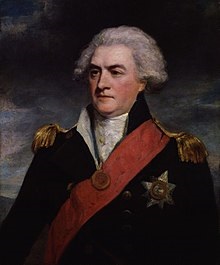 Admiral Adam Duncan 1st Viscount Duncan 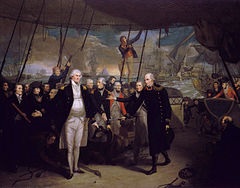 Duncan Receiving the Surrender of De Winter at the Battle of Camperdown 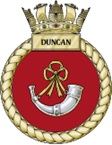 HMS Duncan Ship Badge |
September 2024
The River Thames Luncheon Club
The Watermens
Hall,
City of London EC3R 8EF
September 2024
|
Menu
Friday 13th September 2024 Menu |
Wines
Barão de Vilar White Port
&&&
|
Dates 2024
January - Fully Booked Past Menus on www.thecokkandthebutler.co.uk
|
|
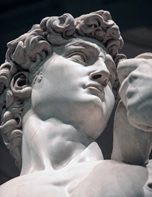
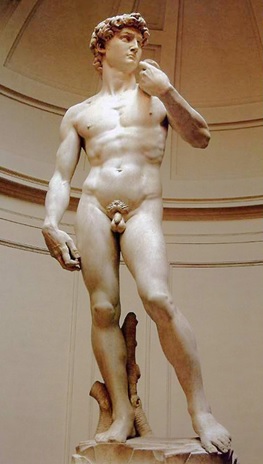
Michelangelo di Lodovico Buonarroti Simoni Born 6th March 1475 Died 18th February
1564 An Italian sculptor, painter, architect and
poet of the High
Renaissance. Born in the Republic
of Florence, his work was inspired by
models from classical
antiquity and had a lasting influence
on Western
art. Michelangelo's creative abilities
and mastery in a range of artistic arenas define him as an
archetypal Renaissance
man, Given the sheer volume of
surviving correspondence, sketches, and reminiscences,
Michelangelo is one of the best-documented artists of the 16th
century. Michelangelo was only
twenty-six years old when he won the contract for David. He
began work on September 13th 1501 The contract provided him a
workspace in the Opera di Santa Maria del Fiore behind
the Duomo, paid him a salary of six Fiorini per
month, and allowed him two years to complete the sculpture Michelangelo's David-The
most famous statue in the world? For Michelangelo, his statue
of David proved to be a defining moment in his artistic career.
The story begins with a commission for a statue of David dating
as far back as 1466 when the artist Agostino di Duccio began
work on the marble block. Agostino did not make much progress,
only managing to mark out the shape of the legs, feet and
drapery, his work on the project ceased for reasons that remain
unclear. The project was resurrected some ten years later when
the artist Antonio Rossellino worked on the statue, but his
contract was terminated with no real progression being made.
The marble
block, purchased from the famous quarries at Carrara, remained
in the courtyard workshop of Florence Cathedral and lay
neglected for the next twenty-five years. After the success of
the Rome Pieta of 1499-1500 Michelangelo was recognised as a
genius, a master of his craft. The Arte della
Lana was the Guild of Wool Merchants wanted to
revive the abandoned project for David, Michelangelo was the
artist who was offered and accepted this prestigious contract.
Working with a second-hand piece of marble that had deteriorated
during its years of exposure to the elements did not please the
artist, however, the Guild of Wool Merchants did state in
Michelangelo's contract that the stone was "badly roughed |

Portrait by Daniele
da Volterra 1545
 |
July 2024
The River Thames Luncheon Club
The Watermens
Hall,
City of London EC3R 8EF
July 2024
|
Menu
Friday 12th July 2024 |
Wines
Barão de
Vilar White Port
|
Dates 2024
January - Fully Booked Past Menus on www.thecokkandthebutler.co.uk
|
|
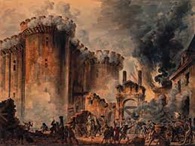
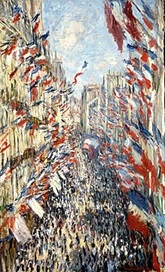
The Fête de la Fédération - July 14th Bastille Day in France The French Revolution began in 1789 and lasted until 1794. King Louis XVI needed more money, but had failed to raise more taxes when he had called a meeting of the Estates General. This instead turned into a protest about conditions in France. On July 14 1789 the Paris mob, hungry due to a lack of food from poor harvests, upset at the conditions of their lives and annoyed with their King and Government, stormed the Bastille fortress prison. This turned out to be more symbolic than anything else as only four or five prisoners were found. In October 1789, King Louis and his family were moved from Versailles the Royal palace to Paris. He tried to flee in 1791, but was stopped and forced to agree to a new form of government. Replacing the power of the King, a ‘legislative assembly’ governed from October 1791 to September 1792, and was then replaced by the ‘National Convention’. The Republic of France was declared, and soon the King was put on trial. The Revolution became more and more radical and violent. King Louis XVI was executed on January 21 1793. In the six weeks that followed some 1,400 people who were considered potential enemies to the Republic were executed in Paris. Many historians now regard the French Revolution as a turning point in the history of Europe, but also in North America where many of the same ideas influenced the Declaration of Independence and the American Revolution. The famous slogan ‘Liberty, Equality and Fraternity’ called for every person’s right to freedom and equal treatment. Across France and the rest of Europe the consequences of the Revolution were huge. There were many new developments including the fall of the monarchy, changes in society with the rise of the middle class, and the growth of nationalism. |
  |
|
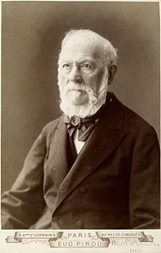
In the debate leading up to the adoption of Bastille Day as a National holiday, Senator Henri Martin, who wrote the National Day law, addressed the chamber on 29 June 1880 Do not forget that behind this 14 July, where victory of the new era over the Ancien Régime was bought by fighting, do not forget that after the day of 14 July 1789, there was the day of 14 July 1790. This day cannot be blamed for having shed a drop of blood, for having divided the country. It was the consecration of the unity of France. If some of you might have scruples against the first 14 July, they certainly hold none against the second. Whatever difference which might part us, something hovers over them, it is the great images of national unity, which we all desire, for which we would all stand, willing to die if necessary. |
 |
June 2024
The River Thames Luncheon Club
The Watermens
Hall,
City of London EC3R 8EF
June 2024
|
Menu
Friday 14th June 2024 Menu |
Wines
Barão de
Vilar White Port
|
Dates 2024
January - Fully Booked Past Menus on www.thecokkandthebutler.co.uk
|

|
At a public meeting in Henley town hall on 26 March 1839,
Captain Edmund Gardiner proposed "that from the lively interest
which had been manifested at the various boat races which have
taken place on the Henley reach during the last few years, and
the great influx of visitors on such occasions, this meeting is
of the opinion that the establishing of an annual regatta, under
judicious and respectable management, would not only be
productive of the most beneficial results to the town of Henley,
but from its peculiar attractions would also be a source of
amusement and gratification to the neighbourhood, and the public
in general. On this day 14th June 1839 the first Henley Regatta
was held. A rowing event held annually on the River Thames by
the town of Henley-on-Thames. The course Henley Regatta has always been raced over a distance of ‘about one mile and 550 yards’ from Temple Island upstream towards Henley Bridge. The Old Course (1839–1885) This ran from a point just upstream of Temple Island. At the first regatta in 1839, the finish line was Henley Bridge itself, but it was presumably quickly realised that this had inherent problems. From 1840 onward the finish was moved downstream slightly; eventually a point opposite the lawn of the Red Lion Hotel became the standard finish line. A grandstand was erected for the Stewards and their guests outside the Red Lion. Other spectators could watch from the adjacent roadway (in front of the Little White Hart Hotel) while those with carriages surveyed the scene from a vantage point on Henley Bridge. There were three racing stations (Berkshire, Centre and Buckinghamshire). The New Course (1886–1922) In 1884, a sub-committee of the regatta's Committee of Management discussed options for reducing the unfairness of the course. Their recommendation was to move the finish line downstream to Poplar Point (thus avoiding the bend) and the start to the bottom of Temple Island. This was not popular with spectators as it made previous viewing points obsolete. The sub-committee also recommending reducing the racing lanes from three to two and extending racing from two days to three. The Committee gained support from the Captains of competing Clubs and the changes were introduced for the 1886 Regatta. |
The Experimental Course (1923) and the Straight Course (1924 onwards) In around 1920, the Stewards carried out a survey canvassing the idea of a moving the start of the course to the Berkshire side of Temple Island. At the time this channel was a winding, shallow backwater and it would clearly not be possible to lay a course of the full Henley distance without significant alteration to the bank, the island and the riverbed. The Straight Course runs from the upstream end of Temple Island to a point opposite the upstream end of the Phyllis Court. The regatta has been known as Henley Royal Regatta since 1851, when Prince Albert became the first royal patron. Since his death, every reigning monarch has agreed to be the patron. The first ‘overseas’ entry to the regatta was in 1870 when Trinity College, Dublin entered the Grand, Ladies’, Visitors’ and Wyfold. As Dublin was at that time within the United Kingdom, this was not a foreign entry. TCD won the Visitors’ and reached the final of the Ladies’. The first international competitors came in 1878 when G.W. Lee of New Jersey and G. Lee of Boston entered the Diamonds, Shoe-wae-cae-mette BC of Monroe, Michigan, a crew of French Canadian watermen, entered the Stewards’ and Columbia College entered the Stewards’ and Visitors’.. 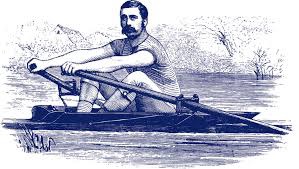 |
May 2024
The River Thames Luncheon Club
The Watermens
Hall,
City of London EC3R 8EF
May 2024
|
Menu
“And somebody grabbed me Threw me out on my chair
“Let’s Say it with Firecrackers” Red Mullet Coated in Sesame Vegetables Basil Compote
(and One More for the Road)
“Top Hat” of Grilled Field Mushroom
Fair Trade Rich Roast Coffee
|
Wines Barão de Vilar White Port |
Dates 2024 January - Fully Booked February - Fully Booked March - Fully Booked Friday - Fully Booked Friday - Fully Booked Friday - Fully Booked Friday - Fully Booked No Luncheon August Friday 13th September Friday - Fully Booked Friday - Fully Booked Friday - Fully Booked Past Menus on www.thecokkandthebutler.co.uk
|
May 2024
|
On This Day May 10th 1899
Frederick Austerlitz was born one of the Greatest Hollywood
stars an
American dancer, actor, singer, choreographer, and presenter. He
is widely regarded as the "greatest popular-music dancer of all
time
Mr Fred Astaire
From a musical Vaudeville
family first performing with his sister Adele. By
age 14, Astaire had assumed the musical responsibilities for his
act. He first met George
Gershwin,
who was working as a song
plugger for Jerome
H. Remick's
music publishing company, in 1916 Astaire had already been
hunting for new music and dance ideas. Their chance meeting was
to affect the careers of both artists profoundly. Astaire was
always on the lookout for new steps on the circuit and was
starting to demonstrate his quest for novelty and perfection.
During the 1920s, Fred and
Adele appeared on Broadway and
the London
stage.
They won popular acclaim with the theatre crowd on both sides of
the Atlantic in shows such as Jerome
Kern's The
Bunch and Judy (1922),
George and Ira
Gershwin's Lady,
Be Good (1924),
and Funny
Face (1927)
and later in The
Band Wagon (1931).
Astaire's tap dancing was recognized by then as among the best.
For example, Robert
Benchley wrote
in 1930, "I don't think that I will plunge the nation into war
by stating that Fred is the greatest tap-dancer in the world."
While in London, Fred studied piano at the Guildhall
School of Music alongside
his friend and colleague Noël
Coward;
and in 1926, was one of the judges at the Charleston Championship
of the World ' competition at the Royal
Albert Hall,
where Lew
Grade was
declared the winner. According to Hollywood folklore, a 1930
screen test report on Astaire for RKO
Radio Pictures,
now lost along with the test, is reported to have read: "Can't
sing. Can't act. Balding. Can dance a little. "However,
this did not affect RKO's plans for Astaire. They lent him for a
few days to MGM in 1933 for his significant Hollywood debut in
the successful musical film Dancing
Lady.
In the movie, he appeared as himself dancing with Joan
Crawford.
On his return to RKO, he got fifth billing after fourth-billed
Ginger Rogers in the 1933 Dolores
del Río vehicle Flying
Down to Rio. pre-Code RKO musical film famous for being the first screen pairing of Fred Astaire and Ginger Rogers.  |
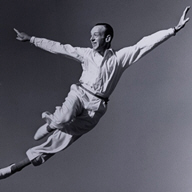 Astaire and Rogers made nine films together at RKO: Flying Down to Rio (1933), The Gay Divorcee (1934), Roberta (1935, in which Astaire also demonstrates his oft-overlooked piano skills with a spirited solo on "I Won't Dance"), Top Hat (1935), Follow the Fleet (1936), Swing Time (1936), Shall We Dance (1937), Carefree (1938), and The Story of Vernon and Irene Castle (1939). Their partnership elevated them both to stardom; as Katharine Hepburn reportedly said, "He gives her class and she gives him sex appeal, Six out of the nine Astaire–Rogers musicals became the biggest money makers for RKO; all of the films brought a certain prestige and artistry that all studios coveted at the time. Astaire revolutionized dance on film by having complete autonomy over its presentation. He is credited with two important innovations in early film musicals. First, he insisted that a closely tracking dolly camera film a dance routine in as few shots as possible, typically with just four to eight cuts, while holding the dancers in full view at all times. This gave the illusion of an almost stationary camera filming an entire dance in a single shot. Astaire famously quipped: "Either the camera will dance, or I will. Astaire's career in stage, film, and television spanned 76 years. He starred in more than 10 Broadway and West End musicals, made 31 musical films, four television specials, and numerous recordings. He received numerous accolades including an Honorary Academy Award, three Primetime Emmy Awards, a BAFTA Award, two Golden Globe Awards, and a Grammy Award. |
April 2024
The River Thames Luncheon Club
The Watermens
Hall,
City of London EC3R 8EF
Friday 12th April 2024
|
Menu
And, most dear actors, eat no onions or garlic
Smithfield Beef Casserole
My lord of Ely, when I was last in Holborn I saw good
strawberries in your garden there;
|
Wines Barão de Vilar White Port |
Dates 2024 January - Fully Booked February - Fully Booked March - Fully Booked Friday - Fully Booked Friday - Fully Booked Friday - Fully Booked Friday - Fully Booked No Luncheon August Friday 13th September Friday - Fully Booked Friday - Fully Booked Friday - Fully Booked Past Menus on www.thecokkandthebutler.co.uk
|
Friday 12th April 2024
|
William Shakespeare was a renowned English poet, playwright, and actor born in 1564 in Stratford-upon-Avon. His birthday is most commonly celebrated on 23 rd April , which is also believed to be the date he died in 1616. Shakespeare was a prolific writer during the Elizabethan and Jacobean ages of British theatre Shakespeare’s plays are perhaps his most enduring legacy, but they are not all he wrote. Shakespeare’s poems also remain popular to this day. Shakespeare's career jump-started in London. THE 16TH CENTURY He also became a founding member of The Lord Chamberlain’s Men, a company of actors. Shakespeare was the company,s regular dramatist, producing on average two plays a year, for almost twenty years. The company was founded during the reign of Queen Elizabeth in 1594, under the patronage of Henry Carey, 1st Baron Hunsdon, the then Lord Chamberlain, who was in charge of court entertainments. For most of its life, the company was one of the most prominent of its day, favoured by commoners and aristocracy alike – indeed The Lord Chamberlain’s Men was often invited to perform at Court, and records show that Queen Elizabeth I preferred them above all other companies. Such was the enthusiasm of the next monarch, James I, he even agreed to grant the company Royal Patronage. From 1594 the players performed at The Theatre, in Shoreditch. Problems with the landlord caused the company to move to the nearby Curtain Theatre in 1597. On the night of 29 December 1598, The Theatre was dismantled by the Burbage brothers, along with William Smith, their financial backer, Peter Street, a carpenter, and ten to twelve workmen. The beams were then carried south of the river to Southwark to form part of their new playhouse, the Globe Theatre. Built in 1599, this theatre was destroyed in a fire on 29 June 1613. The Globe was rebuilt by June 1614 and finally closed in 1642. The company also toured Britain, and visited France and Belgium. 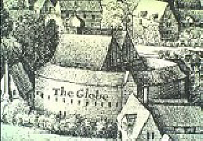 |
THE 21ST CENTURY Founded in 2004 and named after the company that Shakespeare was a part of and for whom he wrote some of his most famous and greatest plays, The Lord Chamberlain’s Men has established itself as the UK’s premier open air touring theatre company. Touring to over 70 venues throughout the UK and internationally over the summer months, The Lord Chamberlain’s Men brings its unique blend of all male Shakespearean entertainment to the most beautiful and historically significant open air venues. Audiences sit under the stars, sip a glass of wine and enjoy a picnic while being enthralled in true Elizabethan fashion. The company follow the same principles that Shakespeare himself championed: clear, bold and dynamic storytelling in the open air, seasoned with a healthy dose of music, songs and dance combine to make a Lord Chamberlain’s Men production the perfect way to spend a summer’s evening. Focusing on the watchwords of Authenticity, Excellence and Magic our productions have audiences coming back year after year. Over the last decade and more The Lord Chamberlain’s Men have gone from strength to strength, and continue to enhance their reputation as the UK’s most popular outdoor touring Shakespeare company. Renowned for high-quality, standard-setting productions the company is also leads the sector in the standard of their working practices. HAMLET TOUR 31ST MAY – 19TH SEPTEMBER 2024 Sat 3rd August 2024 5:30PM St John's Lodge Garden Regent Park London NW1 4NR Sat 3rd August 2024 5:30PM 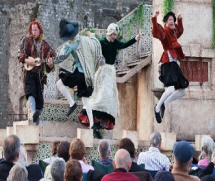 |
March 2024
The River Thames Luncheon Club
The Watermens
Hall,
City of London EC3R 8EF
Friday 8th March 2024
|
Menu
Roasted Butter Nut Squash Soup
|
Wines Barão de Vilar White Port |
Dates 2024 January - Fully Booked February - Fully Booked March - Fully Booked Friday - Fully Booked Friday - Fully Booked Friday - Fully Booked Friday - Fully Booked No Luncheon August Friday 13th September Friday - Fully Booked Friday - Fully Booked Friday - Fully Booked Past Menus on www.thecokkandthebutler.co.uk
|
Friday 8th March 2024
|
British throne ascended by Queen Anne (1665 –1714) On this day in 1702, Anne became the last Stuart monarch of Great Britain, having earlier acquiesced to the Act of Settlement of 1701, which designated as her successors the Hanoverian descendants of King James I. was Queen of Great Britain and Ireland following the ratification of the Acts of Union on 1 May 1707, which merged the kingdoms of Scotland and England. Prior to this, she was Queen of England, Scotland, and Ireland from 8 March 1702. Anne was born during the reign of her uncle King Charles II. Her father was Charles's younger brother and heir presumptive, James, whose suspected Roman Catholicism was unpopular in England. On Charles's instructions, Anne and her elder sister Mary were raised as Anglicans. Mary married their Dutch Protestant cousin, William III of Orange, in 1677, and Anne married Prince George of Denmark in 1683. On Charles's death in 1685, James succeeded to the throne, but just three years later he was deposed in the Glorious Revolution of 1688. Mary and William became joint monarchs. Although the sisters had been close, disagreements over Anne's finances, status, and choice of acquaintances arose shortly after Mary's accession and they became estranged. William and Mary had no children. After Mary's death in 1694, William reigned alone until his own death in 1702, when Anne succeeded him. In the opinion of modern historians, traditional assessments of Anne as fat, constantly pregnant, under the influence of favourites, and lacking political astuteness or interest may derive from sexist prejudices against women. Author David Green noted, "Hers was not, as used to be supposed, petticoat government. She had considerable power; yet time and time again she had to capitulate." Gregg concluded that Anne was often able to impose her will, even though, as a woman in an age of male dominance and preoccupied by her health, her reign was marked by an increase in the influence of ministers and a decrease in the influence of the Crown. Ascot Racecourse was founded in 1711 by Queen Anne. |
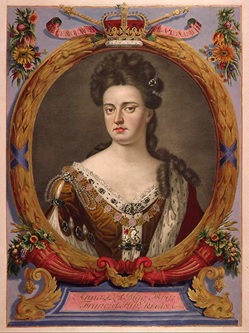 She attended more cabinet meetings than any of her predecessors or successors, and presided over an age of artistic, literary, scientific, economic and political advancement that was made possible by the stability and prosperity of her reign. In architecture, Sir John Vanbrugh constructed Blenheim Palace and Castle Howard. Queen Anne-style architecture and Queen Anne-style furniture were named after her. Writers such as Daniel Defoe, Alexander Pope, and Jonathan Swift flourished. Henry Wise laid out new gardens at Blenheim, Kensington, Windsor and St James's. The union of England and Scotland, which Anne had fervently supported, created Europe's largest free trade area. The political and diplomatic achievements of Anne's governments, and the absence of constitutional conflict between monarch and parliament during her reign, indicate that she chose ministers and exercised her prerogatives wisely. |
February 2024
The River Thames Luncheon Club
The Watermens
Hall,
City of London EC3R 8EF
Friday 9th February 2024
|
Menu
Forest of Dean Leek & Coriander Soup
|
Wines Barão de Vilar White Port |
Dates 2024 January - Fully Booked February - Fully Booked March - Fully Booked Friday - Fully Booked Friday - Fully Booked Friday - Fully Booked Friday - Fully Booked No Luncheon August Friday 13th September Friday - Fully Booked Friday - Fully Booked Friday - Fully Booked Past Menus on www.thecokkandthebutler.co.uk
|
9th February International Chocolate Day
|
History of Chocolate Day Part of week-long celebration in conjunction of Valantine Day Six days of celebration because everyone knows that chocolate is just one that lovers romantics and caterers show how much they are adored. |
Rose Day (February 7), Propose Day (February 8), Chocolate Day (February 9), Teddy Day (February 10), Promise Day (February 11), Kiss Day (February 12), Hug Day (February |
|
Chocolate or cocoa is a food made from roasted
and ground cacao seed kernels that is available as a liquid,
solid, or paste, either on its own or as a flavoring agent in
other foods. Cacao has been consumed in some form since at least the Olmec civilization (19th–11th century BCE), and the majority of Mesoamerican people, including the Maya and Aztecs, made chocolate beverages. The seeds of the cacao tree have an intense bitter taste and must be fermented to develop the flavor. After fermentation, the seeds are dried, cleaned, and roasted. The shell is removed to produce cocoa nibs, which are then ground to cocoa mass, unadulterated chocolate in rough form. Once the cocoa mass is liquefied by heating, it is called chocolate liquor. The liquor may also be cooled and processed into its two components: cocoa solids and cocoa butter. Baking chocolate, also called bitter chocolate, contains cocoa solids and cocoa butter in varying proportions without any added sugar. Powdered baking cocoa, which contains more fiber than cocoa butter, can be processed with alkali to produce Dutch cocoa. Much of the chocolate consumed today is in the form of sweet chocolate, a combination of cocoa solids, cocoa butter, or added vegetable oils and sugar. Milk chocolate is sweet chocolate that additionally contains milk powder or condensed milk. Chocolate is one of the most popular food types and flavors in the world, and many foodstuffs involving chocolate exist, particularly desserts, including cakes, pudding, mousse, chocolate brownies, and chocolate chip cookies. Many candies are filled with or coated with sweetened chocolate. Chocolate bars, either made of solid chocolate or other ingredients coated in chocolate, are eaten as snacks. Gifts of chocolate molded into different shapes (such as eggs, hearts, and coins) are traditional on certain Western holidays, including Christmas, Easter, Valentine's Day, and Hanukkah. Chocolate is also used in cold and hot beverages, such as chocolate milk and hot chocolate, and in some alcoholic drinks, such as creme de cacao. Although cocoa originated in the Americas, West African countries, particularly Côte d'Ivoire and Ghana, are the leading producers of cocoa in the 21st century, accounting for some 60% of the world cocoa supply. |
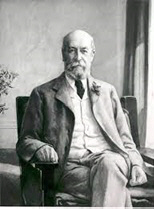 John Cadbury
(12 August 1801 – 11 May 1889) was a Quaker and English
proprietor, tea and coffee trader and founder of Cadbury,
the chocolate business based in Birmingham, England |
January 2024
The River Thames Luncheon Club 12th January 2024
|
Menu
Red Onion Soup
|
Wines Barão de Vilar White Port |
Dates 2024 January - Fully Booked February - Fully Booked March - Fully Booked Friday 12th April Friday 10th May Friday 14th June Friday 12th July No Luncheon August Friday 13th September Friday 11th October Friday 8th November Friday 13th December Past Menus on www.thecokkandthebutler.co.uk
|
|
The National Trust is a charity
and membership organisation for heritage Conservation
in England, Wales and Northern Ireland. Historically, the Trust acquired land by gift and sometimes by public subscription and appeal, but after World War II the loss of country houses resulted in many such properties being acquired either by gift from the former owners or through the National Land Fund. Country houses and estates still make up a significant part of its holdings, but it is also known for its protection of wild landscapes such as in the Lake District and Peak District.
It also receives grants from a variety of organisations including other charities, government departments, local authorities, and the National Lottery Heritage Fund.
The
first building the Trust acquired was As of 2020 more than 200 historic houses, 41 castles and chapels, 47 industrial monuments and mills, the sites of factories and mines, nine lighthouses, 56 villages, 39 public houses, and 25 medieval barns.
|
The Trust was incorporated on 12 January 1895 as the "National Trust for Places of Historic Interest or Natural Beauty", which is still the organisation's legal name.
The
founders were social reformer Octavia Hill, solicitor Sir Robert
Hunter and clergyman Hardwicke Rawnsley. In 1876, Hill, together with her sister Miranda Hill had set up a society to "diffuse a love of beautiful things among our poor brethren". Named after John Kyrle, the Kyrle Society campaigned for open spaces for the recreational use of urban dwellers, as well as having decorative, musical, and literary branches.
Hunter had been solicitor to the Commons Preservation Society, while Rawnsley had campaigned for the protection of the Lake District. The idea of a company with the power to acquire and hold buildings and land had been mooted by Hunter in 1894. In July 1894 a provisional council, headed by Hill, Hunter, Rawnsley and the Duke of Westminster met at Grosvenor House and decided that the company should be named the National Trust for Places of Historic Interest or Natural Beauty. Articles of association were submitted to the Board of Trade and on 12 January 1895, the Trust was registered under the Companies Act. Its purpose was to "promote the permanent preservation for the benefit of the Nation of lands and tenements of beauty or historic interest".
Most visited properties |
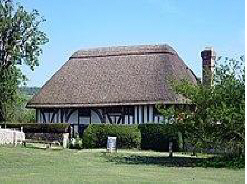
December 2023
The River Thames Luncheon Club 8th December 2023
|
Menu
Roasted Parsnip & Butter
Nut Squash Soup Selection of Breads &&& Roasted Fillet of
Sea Bass Champagne Sauce Samphire Salad
&&&
Medallion of Balmoral
Venison
Grand Veneur
Sauce
Bryon Potatoes
Organic Baby Vegetables &&&
The Old Contemptible
British Expeditionary Force Autumn Crumble of Pear &
Blackberry Classic English Custard
Sauce Clotted Cream Ice Cream &&&
Filld Mushroom with Blue Cheese
Stilton Souffle
Corn Salad Washed in Truffle Oil
&&&
Fair Trade Rich Roast
Coffee Tregothnan Cornish Estate
Grown Tea |
Wines
&&& Pinot Grigio 2022 Provincia di Pavia Ancora Lombardy &&& The {SUM} Cabernet Sauvignon 2019 Castelli Estate, Denmark, Western Australia &&& Gewürztraminer Late Harvest Spätlese 2021 Julius Hafner Mönchhof Neusiedlersee &&& Barão de Vilar Port
|
Dates 2024 January - Fully Booked
February - Fully Booked
March - Fully Booked Friday 12th April Friday 10th May Friday 14th June Friday 12th July
Friday 11th October Friday 8th November Friday 13th December Past Menus on
|
|
John Taylor - The Watermens Poet Born in the parish of St. Ewen's, near South Gate, Gloucester on 24 August 1578. In the early 1590s, after his attempt at grammar school he moved from his home to south London, probably Southwark , to begin an apprenticeship as a waterman . His occupation was one deemed unpopular by the literary elite of London. Watermen were known to be drunkards, and often gossips and liars, who attempted to cheat patrons into a higher wage for their service. This occupation would be crafted into an image for Taylor later in his career. He spent much of his life as a Thames waterman , a member of the guild of boatmen that ferried passengers across the River Thames in London , in the days when the London Bridge was the only passage between the banks. His occupation was his gateway into the literary society of London, as he ferried patrons, actors, and playwrights across the Thames to the Bankside theatres. In 1620, Taylor claimed almost 20,000 men lived by this trade, including dependents and servants, and in 1641, he believed there were over 40,000 in the company itself He became a member of the ruling oligarchy of the guild, serving as its clerk; Taylor discusses the watermen's disputes with the theatre companies who moved the theatres from the south bank to the north in 1612, The move of theatres from the south bank to the north took a huge toll on Taylor's income, and despite at that time being in the company of the King's Watermen, he could not sway the king to prevent the move. Taylor was also the first poet to mention the deaths of William Shakespeare and Francis Beaumont in print, in his 1620 poem, "The Praise of Hemp-seed". Both had died four years earlier. He was a prolific poet, with over one hundred and fifty publications in his lifetime. Although his work was not sophisticated, he was a keen observer of people and styles in the seventeenth century, and his work is often studied by social historians. Taylor died in London in December 1653 aged 75. He was buried on 5 December at the church of St Martin- in-the-Fields . “He entertained no gout, no ache he felt, The air was good and temperate where he dwelt; While mavisses and sweet-tongued nightingales Did chant him roundelays and madrigals. Thus living within bounds of nature's laws, Of his long-lasting life may be some cause” |
Christmas 2023 is the 376th anniversary of the Plum Pudding Riots that followed Parliament’s clamp down on Christmas in 1647, In 1644, the Puritans gained control of Parliament. With Grinch-like fervour they set about cancelling Christmas. At a stroke, the traditional 12-day festival – a prolonged period of merriment and revelry characterised by rich food, dancing and excess – was banned. The Puritans regarded Christmas celebrations as sinful, ‘giving liberty to carnal and sensual delights’. Even worse, the traditional decorations of holly, ivy, rosemary and bays were pagan. To bring the country to its senses – or its knees – Christmas Day was initially turned into a day of fasting and repentance until, in June 1647, it was abolished altogether. 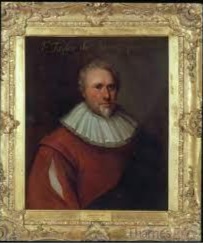 John Taylor created the idea of Father Christmas and the Man who saved Christmas “Let’s dance and sing and make good cheer, since Christmas comes back once a year” John Taylor In his pamphlet The Vindication of Christmas written in 1652 stood up to the Puritan assault on Christmas tradition. The cover of John Taylor’s pamphlet personified Christmas and championed the customs of the common man against what Taylor felt were the beliefs of a minority - The world upside down “All the liberty and harmless sports, with the merry gambols, dances and friscals [by] which the toiling plowswain and labourer were wont to be recreated and their spirits and hopes revived for a whole twelve month are now extinct and put out of use in such a fashion as if they never had been. Thus are the merry lords of misrule suppressed by the mad lords of bad rule at Westminster” |
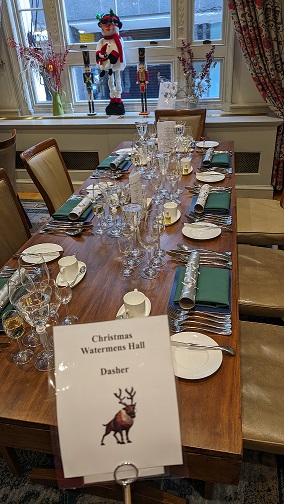
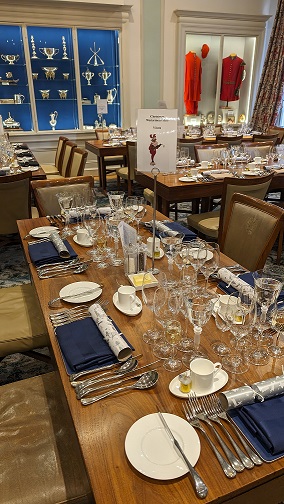
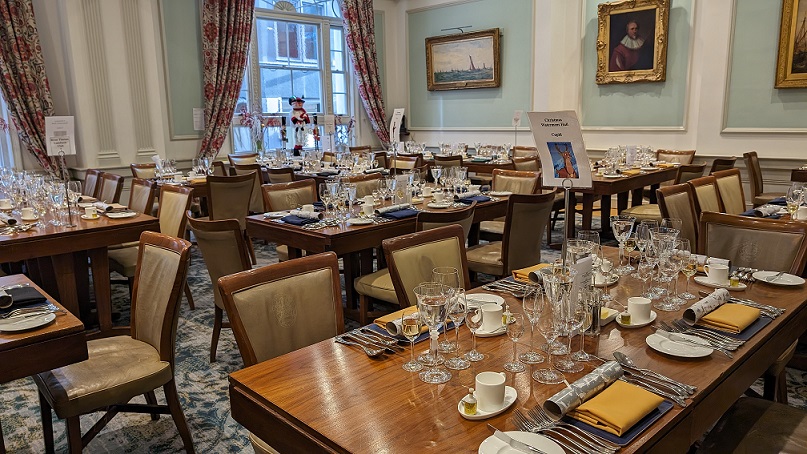
November 2023
The River Thames Luncheon Club 10th November 2023
|
Menu
&&&
Roast Breast of Goose & Confit of Leg & Ginger CrustRosemerry Jus Potatoes Carrots
&&&
Traditional Christmas Pudding Clotted Cream
&&&
Billingsgate Bobbin Cake
Fair Trade Rich Roast
Coffee Tregothnan Cornish Estate
Grown Tea Mince Pies & Brandy
Butter |
Wines
&&&
& && Neusiedlersee
|
Dates 2024 January - Fully
Booked
February - Fully Booked
Friday 10th May Friday 14th June Friday 12th July
Friday 11th
October Friday 8th
November
Past Menus on
|
The River Thames Luncheon Club Friday 10th November 2023
|
A
Solider of the First World enjoying a daily ration
But their diet also included vegetables, bread and jam, and boiled plum puddings. This was all washed down by copious amounts of tea. The 'reserve ration' was carried by every soldier in his backpack. It included canned meat, dried bread, sugar, coffee and salt. It was meant to be used when, for whatever reason, it was not possible to eat the food prepared in the
|
The Unknown Warrior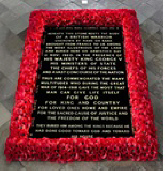 At the west end of the Nave of Westminster Abbey is the grave of the Unknown Warrior, whose body was brought from France to be buried here on 11th November 1920. The grave, which contains soil from France, is covered by a slab of black Belgian marble from a quarry near Namur featuring this inscription, composed by Herbert Edward Ryle, Dean of Westminster, engraved with brass from melted down wartime ammunition. Beneath this stone rests the body Of a British warrior Unknown by name or rank Brought from France to lie among The most illustrious of the land And buried here on Armistice Day 11 Nov: 1920, in the presence of His Majesty King George V His Ministers of State The Chiefs of his forces And a vast concourse of the nation Thus are commemorated the many Multitudes who during the Great War of 1914 – 1918 gave the most that Man can give life itself For God For King and country For loved ones home and empire For the sacred cause of justice and The freedom of the world They buried him among the kings because he Had done good toward God and toward His house A year later, on 17th October 1921, the unknown warrior was given the United States' highest award for valour, the Medal of Honor, from the hand of General John Pershing; On 11 November 1921, the American Unknown Soldier was reciprocally awarded the Victoria Cross |
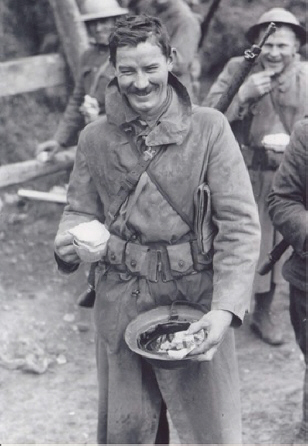
October 2023
The River Thames
Luncheon Club Friday 13th
October 2023 (72 Days Till Christmas)
|
Menu Sweet Potato & Coriander Soup Selection of Breads &&& Serb Ceviche Sea Bass Cocktail Pomegranate Compote &&& Ballantine of Cornfed Chicken Rich Mushroom & Pisco Peruvian Brandy Sauce Potato Cake Stir Fried Vegetables &&& Aunt Pastuzo Bread & Butter Pudding Marmalade Ice Cream Marmalade sandwiches are Paddington Bear's favourite food in the world. Paddington's Aunt Lucy taught him how to make marmalade sandwiches back in the jungles of Darkest Peru. His Uncle Pastuzo always kept a marmalade sandwich under his red bucket hat 'in case of emergency &&& Warm Spinach & Feta Tart Caramelised Red Pepper Drizzle &&& Fair Trade Rich Roast Coffee Tregothnan Cornish Estate Grown Tea Marmalade Chocolate Truffles |
Wines Barão de Vilar White Port
|
Dates 2024 Friday 12th JanuaryFriday 9th February Friday 8th March Friday 12th April Friday 10th May Friday 14th June Friday 12th July No Luncheon August Friday 13th September Friday 11th October Friday 8th November Friday 13th December |
Paddington Bear - A fictional character in children's literature.
He first appeared on 13
October 1958
|
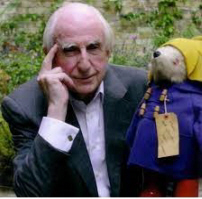

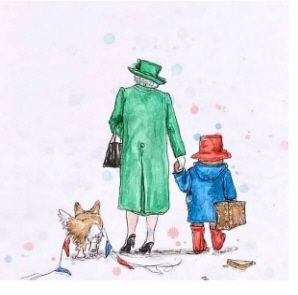
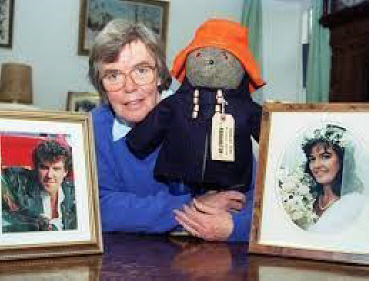

September 2023
The River Thames
Luncheon Club Friday 8th 2023
|
Menu Rodney On Del Boy's
Cooking !!! "If you had been in
charge of The last supper it would have been a take away."
Menu Sid’s Café - Soup of the
Day
Mike Said: ‘Ere, Del. You speak a bit of French, don’t ya?
Del: What? Potage bonne femme.”
Leek and
Potato Soup
&&&
The Star of Bengal Indian
Restaurant in Peckham
which Derek "Del Boy" Trotter his
brother Rodney Dine Fish on Friday
Tempura of
Red Mullet Indian Spices
&&&
Del Boy On Ordering Food
In France "One of my most
favouritist meals is Duck à l'Orange,
but I don't know how to say that in
French."
Slow Cooked Brest Magret Duck
Caramelised Orange Sauce
Chateau Potatoes
Glazed Baby Vegetables
&&&
Pudding Del “Don’t worry, Rodney, this time next year we’ll be millionaires!”:
“Millionaire Cheese Cake”
&&& Del Said: As Macbeth said to Hamlet in
‘We’ve been done up like a
couple of kippers.’ Arbroath Smokies Fish Cake
&&&
Fair Trade Rich Roast Coffee
Tregothnan Cornish Estate Grown
Tea |
Wine Barão de Vilar White Port &&& Chardonnay 2020 IGP Pays d'Oc Domaine de la Provenquière &&&
Rioja Crianza 2019
Bodegas Muriel
&&& Muskat Ottonel Late Harvest
Spätlese 2018 &&& Tayors 2012 |
Friday 8th September Friday 13th October Friday 10th November Fridat 8th December |
|
Rodney On Del
Boy's Cooking !!!
"If you had been in charge of The last supper it would have been
a take away."
&&&
Sid’s Café
Soup of the Day
Del Boy's:
Saying No problem -
"Mange tout”
Mike
Said: ‘Ere, Del. You speak a bit of French, don’t ya?
Del:
What? Potage bonne femme.”
The Star Of Bengal Indian
restaurant in Peckham
which Derek "Del Boy" Trotter his brother Rodney Dine
Del Boy On Ordering Food In France
"One of my most
favouritist meals is Duck à l'Orange, but I don't know how to
say that in French."
Trigger said; Don’t
know what your worried about I’ve been eating beef all me life
The Nags Head Beef Stew
Pie
Uncle Alberts Navy
Gravy
“Don’t worry, Rodney, this time next year we’ll be
millionaires!”:
Cushty Biscuit
Del
Said: As Macbeth said
to Hamlet in A
Midsummer Night’s Dream,
‘We’ve been done up like a couple of kippers.’
|
July 2023
The River Thames
Luncheon Club Friday 14th
July 2023
|
Soupe froide courgettes au fromage de chèvre fleur de solgne Chilled Courgette & Fleur de Solgne Goats Cheese Toasted Brioche &&& Bourride de poissons au safran Mediterranean Fish Casserole Saffron Sauce Reduction &&& Filet de boeuf a la moelle Sauce Bourgogne Pomme de terre anna petits légumes garnis Beef & Bone Marrow Burgundy Wine Sauce Pommes Anna Petit Pois à la Francaise &&& Paris Brest Sauce caramel glace praliné Paris Breast Toffee Sauce Praline Ice Cream &&& Petit munster au cumin en croûte Munster Cumin Cheese En Croute &&& Café et Cannelés Café de Paris Canneles |
Lillet
Blanc &&& Touraine Sauvignon Blanc 2022 Antoine Simoneau &&& Famille Bouey Vin de Fête de la Fédération &&& Muskat Ottonel Late Harvest Spätlese 2018 &&& Barão de Vilar Ruby Port |
Friday 8th September Friday 13th October Friday 10th November Fridat 8th December |
|
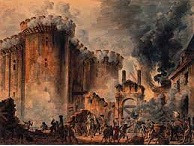
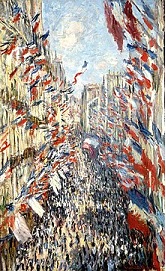
June 2023
Men
Menu
Corn Soup From The Field Duck Burg
Selection of Breads
&&&
The Sailor’s Hornpipe – Bucket of the Fantasea of the Sea Harvest
Atlantic Cod Scottish Salmon
Norfolk Samphire
Saffron Sauce
&&&
Confit of Daisy Duck
The Ludwig Von Drake Sauce
Pullet Potatoes
Medley of Technicolour Vegetables
&&&
Sweet Donald
&&&
Savoury of Duck & Waffle
&&&
Fair Trade Rich Roast Coffee
Tregothnan Cornish Estate Grown Tea
Chocolate Truffles
Friday 9th June 1934
| The Wise Little Hen first shown 9th June 1934 a Walt Disney's Silly symphony cartoon, based on the fable The Little Red Hen. The cartoon features the debut of Donald Duck, dancing to the Sailor's Hornpipe. Donald and his friend Peter Pig try to avoid work by faking stomach aches until Mrs. Hen teaches them the value of labour. Donald Fauntleroy Duck is a cartoon character created by The Walt Disney Company. Donald is an anthropomorphic white duck with a yellow-orange bill, legs, and feet. He typically wears a sailor shirt and cap with a bow tie. Donald is known for his semi-intelligible speech and his mischievous, temperamental, and pompous personality. Along with his friend Mickey Mouse, Donald was included in TV Guide's list of the 50 greatest cartoon characters of all time in 2002, and has earned a star on the Hollywood Walk of Fame. He has appeared in more films than any other Disney character, and is the most published comic book character in the world outside of the superhero genre |
  |
|
The Wise Little Hen of the title is looking for someone to help her plant her corn for the winter. Peter Pig and Donald Duck both feign belly aches to get out of the chore, since they would rather play than work. So, with help from her chicks, she plants it herself. Harvest time comes; again, Peter and Donald claim belly aches, but the hen sees through this when boards of their clubhouse fall off showing their little act when they shake hands with each other for evading responsibility. Upon wising up to their ruse, she and her chicks wink at each other upon knowing what to do with Peter and Donald later. She cooks up a tantalizing assortment of corn dishes, and heads over to Peter and Donald to help her eat them, but before she can open her mouth, they already fake their belly aches. |
Once she asks them
to help her eat the corn, they snap out of their façade and are
excited to eat, but all she gives them is castor oil. As the hen
and her chicks eat the corn themselves, Peter and Donald repent
with all their might by kicking each other in the rump. |
May 2023
Menu
The Bossin
Navy Bean Soup
Selection of Breads
&&&
Caramelised Irish Salmon
Samphire & Shalott Salad
Lime Hollandaise Sauce
&&&
Duo of Roasted Coastal Lamb from the West Country,
Confit Lemon Flavoured Jus
Fennel Hearts Barigoule Style
&&&
Bergeron Apricot Iced Parfait
Honey Ice Cream
&&&
The Coronation Quiche
&&&
Fair Trade Rich Roast Coffee
Tregothnan Cornish Estate Grown Tea
Chocolate Truffles
|
HMS Beagle |
The ship was one of the first to be fitted with the lightning conductor invented by William Snow Harris 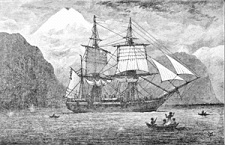 HMS Beagle in the Straits of Magellan at Monte Sarmiento,.  The Beagle Laid Ashore drawn by Conrad Martens 1834 |
April 2023
The King's Men is the acting company to which William
Shakespeare (1564–1616)
belonged for most of his career. Formerly known as the Lord
Chamberlain's Men
during the reign of Queen Elizabeth I, they became the King's Men in
1603
when King James I ascended the throne and became the company's patron
Antony and Cleopatra - William Shakespeare
The play was first performed, by the King's Men at either
the Blackfriars Theatre or the Globe Theatre in around 1607
|
SCENE II |
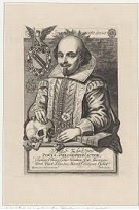 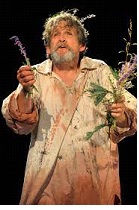 |
Dorset’s Peter Morgan of the Book &
Bucket Cheese Company
Wimborne in Dorset makes a wide range of different cheeses named
after authors. Including several made with sheep’s' milk.
Here's Shakespeare, a
beautiful soft cheese with a bloomy white rind.
Pasteurised, vegetarian.
May 2023
Menu
The Bossin
Navy Bean Soup
Selection of Breads
&&&
Caramelised Irish Salmon
Samphire & Shalott Salad
Lime Hollandaise Sauce
&&&
Duo of Roasted Coastal Lamb from the West Country,
Confit Lemon Flavoured Jus
Fennel Hearts Barigoule Style
&&&
Bergeron Apricot Iced Parfait
Honey Ice Cream
&&&
The Coronation Quiche
&&&
Fair Trade Rich Roast Coffee
Tregothnan Cornish Estate Grown Tea
Chocolate Truffles
|
HMS Beagle |
The ship was one of the first to be fitted with the lightning conductor invented by William Snow Harris HMS Beagle in the Straits of Magellan at Monte Sarmiento,. The Beagle Laid Ashore drawn by Conrad Martens 1834 |
June 2023
Menu
Menu
Corn Soup From The Field Duck Burg
Selection of Breads
&&&
The Sailor’s Hornpipe – Bucket of the Fantasea of the Sea Harvest
Atlantic Cod Scottish Salmon
Norfolk Samphire
Saffron Sauce
&&&
Confit of Daisy Duck
The Ludwig Von Drake Sauce
Pullet Potatoes
Medley of Technicolour Vegetables
&&&
Sweet Donald
&&&
Savoury of Duck & Waffle
&&&
Fair Trade Rich Roast Coffee
Tregothnan Cornish Estate Grown Tea
Chocolate Truffles
Friday 9th June 1934
| The Wise Little Hen first shown 9th June 1934 a Walt Disney's Silly symphony cartoon, based on the fable The Little Red Hen. The cartoon features the debut of Donald Duck, dancing to the Sailor's Hornpipe. Donald and his friend Peter Pig try to avoid work by faking stomach aches until Mrs. Hen teaches them the value of labour. Donald Fauntleroy Duck is a cartoon character created by The Walt Disney Company. Donald is an anthropomorphic white duck with a yellow-orange bill, legs, and feet. He typically wears a sailor shirt and cap with a bow tie. Donald is known for his semi-intelligible speech and his mischievous, temperamental, and pompous personality. Along with his friend Mickey Mouse, Donald was included in TV Guide's list of the 50 greatest cartoon characters of all time in 2002, and has earned a star on the Hollywood Walk of Fame. He has appeared in more films than any other Disney character, and is the most published comic book character in the world outside of the superhero genre |
|
|
The Wise Little Hen of the title is looking for someone to help her plant her corn for the winter. Peter Pig and Donald Duck both feign belly aches to get out of the chore, since they would rather play than work. So, with help from her chicks, she plants it herself. Harvest time comes; again, Peter and Donald claim belly aches, but the hen sees through this when boards of their clubhouse fall off showing their little act when they shake hands with each other for evading responsibility. Upon wising up to their ruse, she and her chicks wink at each other upon knowing what to do with Peter and Donald later. She cooks up a tantalizing assortment of corn dishes, and heads over to Peter and Donald to help her eat them, but before she can open her mouth, they already fake their belly aches. |
Once she asks them
to help her eat the corn, they snap out of their façade and are
excited to eat, but all she gives them is castor oil. As the hen
and her chicks eat the corn themselves, Peter and Donald repent
with all their might by kicking each other in the rump. |